Raxivort
The cunning Lord of Xvartkind, whose followers prize stealth, theft, patience, and survival over courage or honor.
Overview
Of the lesser powers worshipped by the humanoid races, Raxivort is among the more curious. He is called the Lord of Xvartkind, the Packmaster of Rats, and, in several less complete accounts, Night Flutter. His worship appears to be confined almost entirely to the xvarts themselves, although giant rats and great bats are frequently associated with his shrines and priests.
What makes Raxivort unusual is that xvart tradition does not describe him as their creator. Quite the contrary: Raxivort was supposedly once an ordinary xvart.
I would normally advise some caution whenever a people conveniently claim that one of their ancestors rose to godhood. In this case, however, the story appears in enough independent accounts that I am inclined to accept at least the broad outline.
Raxivort is said to have entered the service of the demon lord Graz’zt, eventually becoming his Master of Slaves. Precisely how a creature as small and apparently insignificant as a xvart attained such a position is not recorded. Knowing xvarts, I suspect the answer involved considerably less heroism than patience, flattery, and knowing when not to be noticed.
While serving Graz’zt, Raxivort accumulated knowledge, influence, and opportunity. Eventually he plundered his master’s treasure vaults and fled. The xvarts consider this the single greatest achievement in their history. That fact tells us nearly as much about the xvarts as it does about their god.
The God Himself
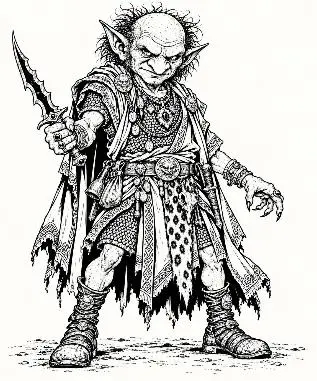
Descriptions of Raxivort are remarkably consistent. He most often appears as an exceptionally powerful xvart, somewhat larger than his followers, with bright blue skin and burnt-orange eyes. His face is broad and unpleasant, with a prominent nose, pointed ears, and an expression variously described as suspicious, amused, or calculating.
Unlike the ragged creatures usually encountered in the wild, Raxivort dresses extravagantly. Accounts describe fine silken garments worn over blue mail, along with jewelry and other valuables. Whether all of these ornaments are actually stolen is impossible to determine, although xvart storytellers clearly prefer to believe they are.
He favors knives, daggers, and short swords. The weapon most often associated with him is called the Azure Razor, apparently a short and particularly vicious blade.
Raxivort is also reputed to assume the forms of rats, giant rats, bats, and enormous bats sometimes called mobats. Other disguises are possible. Several texts insist that he can appear as a human, demi-human, or humanoid when it suits him.
His most recognizable supernatural sign is blue flame. The principal symbol used by his priests is therefore a hand surrounded by blue fire.
Graz’zt and the Flight
Raxivort apparently did more than simply escape Graz’zt with stolen treasure. Later accounts claim that he attempted to seize a portion of Graz’zt’s Abyssal territory for himself. He failed.
This is worth noting because xvart versions of the story make very little effort to conceal the failure. Instead, they celebrate what Raxivort did afterward. He ran away.
Raxivort abandoned the Abyss and established himself in Pandemonium, carrying whatever treasure and followers he had managed to preserve. To a xvart, this was not cowardice. It was wisdom. Remaining to fight a stronger enemy merely because one has already begun the fight is regarded as the sort of foolishness practiced by larger races.
Here, I believe, we reach the heart of Raxivort’s religion. Raxivort survived.
He served someone stronger when doing so was useful. He learned what he could. He stole what he wanted. When the opportunity came, he betrayed his master. When his ambitions exceeded his strength, he withdrew rather than perish. The xvarts do not worship courage. They worship survival through cunning.
What the Xvarts Learn from Him
A xvart priest would probably find our distinction between virtue and vice rather puzzling.
Theft is admirable if successful. Deception is sensible if believed. Ambush is preferable to a fair fight. Flight is preferable to death. Service to a stronger master is acceptable so long as the servant watches carefully for an opportunity to improve his position.
Treasure carries particular importance. Xvarts seem to regard something successfully stolen and retained as evidence of cleverness. The value of an object is therefore not entirely determined by gold or workmanship. A trinket stolen from a dangerous enemy may carry greater prestige than a richer object acquired without risk.
This also explains why xvart religion appears to place relatively little emphasis upon destroying offerings. Their god stole a fortune and kept it. His followers see little reason why he should suddenly develop a preference for watching valuable objects burn upon an altar.
Xvart shrines are therefore often repositories as much as places of worship: hidden niches, sealed chambers, concealed pits, and caches of objects whose significance may be understood only by the tribe that stole them.
Priests and Worship
Raxivort’s priests are generally described as shamans and witch doctors rather than members of an organized priesthood. Some shamans become surprisingly capable clerics, while witch doctors combine divine practices with simpler forms of magic. Certain accounts specifically associate them with the spell burning hands, presumably because of the god’s connection with blue flame.
Their shrines are rarely grand. Caves, abandoned mines, ruined structures, and concealed chambers are preferred. This is entirely consistent with xvart behavior: a temple visible from the road is a temple someone larger can find.
Priests often advise a tribe’s chieftain, although “advise” may be generous. Xvart political and religious authority seem to overlap considerably, and a strong shaman may be adviser, rival, conspirator, or all three before breakfast.
Rituals appear to vary between tribes, but several practices recur often enough to deserve mention. Stolen goods may be placed temporarily before the sign of the blue hand before being hidden in a sacred cache. Warriors preparing for raids are sometimes marked with blue pigment. Rats and bats are watched for omens, especially at night.
The division of captured treasure itself may possess a religious quality. Unsurprisingly, there are numerous stories of xvarts concealing part of the loot before the official division. Apparently this is considered clever rather than dishonest. One begins to understand them.
A Final Observation
Raxivort should not be dismissed simply as the unpleasant god of an unpleasant little race. His story explains the xvarts remarkably well.
They inhabit a world dominated by creatures larger, stronger, and more numerous than themselves. His divine example does not tell them that they will someday become stronger than their enemies. It teaches them something much more practical:
Watch. Wait. Take what you can. Hide what you have. Run when you must. Survive long enough to try again.
The xvart who lives through disaster has not failed. According to Raxivort, he has merely preserved his next opportunity.
— Vandy Banderdash, Head Librarian of the Hall of Illumination, Scholar of Forgotten Threads, and occasional reader of books whose previous owners really ought to have labeled them more clearly.