Rao
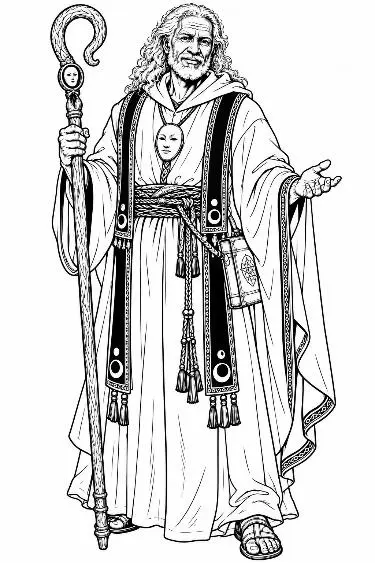
The ancient Flan god of peace, reason, and serenity, whose followers seek calm judgment before anger becomes action.
Overview
Rao is an ancient Flan god of Peace, Reason, and Serenity. He is respected throughout much of the Flanaess, though in Salinmoor he is neither especially prominent nor widely worshipped. Most people have heard his name, but comparatively few would have regular dealings with his priests.
A common person in Salinmoor would probably know Rao as a god of calm judgment, mediation, thoughtful speech, and the peaceful settlement of disputes. His followers believe that anger and haste lead people into mistakes that cannot easily be undone. A Raoan is expected to think before acting, listen before judging, and seek peace before drawing a weapon.
This does not mean that Rao teaches absolute pacifism. The usual understanding is that violence should be the last reasonable course, not that it must never be used. A follower of Rao may defend himself, protect others, or fight against genuine evil when peaceful alternatives have failed. What Rao condemns is violence committed from pride, rage, vengeance, impatience, or simple unwillingness to seek another solution.
The Faith of Rao
Rao’s worship is much older than the kingdoms now surrounding Salinmoor. He is a Flan deity, and traditions concerning him go back to the earliest human peoples of the region.
Learned people may know that Rao’s followers were among the ancient Flan who entered the lands of the Sheldomar Valley long before Keoland existed. Because of this, the occasional old shrine, weathered carving, or local custom associated with Rao need not have anything to do with Veluna or the modern organized church.
In some places, Rao’s worship is little more than an old family tradition or a custom remembered by village elders. A person might leave a white stone at an ancient roadside shrine before attempting an important negotiation. Two families ending a feud might swear their agreement at a place traditionally associated with Rao. An old meeting stone or quiet grove might still be used to settle disputes even when no priest of Rao has lived nearby for generations.
Most people performing such customs may know very little theology. They know only that Rao favors peace honestly reached.
Rao in Salinmoor
Rao is known in Salinmoor, but he is not one of the region’s major public gods. Along the coast, people naturally give greater attention to deities connected with the sea, sailors, trade, storms, protection, and everyday civic life. Rao therefore receives much less public devotion than gods whose concerns are immediately apparent to fishermen, merchants, soldiers, and sailors.
A resident of Seaton or Seaton’s Cove would probably recognize Rao’s name and understand what he represents, but might never have seen a formal temple dedicated to him. A Raoan priest appearing in town would not be considered strange. He would simply be somewhat unusual.
Such a priest would most likely be regarded as a scholar, mediator, teacher, counselor, or traveling holy man rather than as the sort of cleric expected to march at the front of a militia.
Priests of Rao
Priests of Rao have a reputation for being educated and deliberate. They are often asked to settle disputes, witness agreements, advise rulers, interpret difficult questions of law or morality, or persuade enemies to speak before they fight.
They are also known for patience—sometimes rather a great deal of patience. A Raoan priest may spend hours asking questions before offering an opinion. To someone accustomed to immediate action, this can be frustrating. To the priest, however, acting before understanding the problem is often the surest way to make matters worse.
Rao’s clergy are generally associated with white garments, quiet temples, gardens, libraries, incense, philosophical discussion, and meditation. Older Flan shrines can be much simpler. A circle of stones beneath the open sky may be every bit as sacred to Rao as a grand temple.
Rao’s Symbol
Rao is commonly represented by a white mask with a calm expression. Some traditions use a white heart or a heart-shaped mask instead.
The meaning is easily understood: emotion should not rule judgment. The mask does not represent coldness or lack of compassion. It represents the ability to remain calm when anger, fear, or grief would otherwise overwhelm reason.
Rao and Evil
Rao is peaceful, but he is not indifferent to evil. Stories concerning him frequently portray the god resisting forces that bring war, destruction, madness, or needless suffering into the world. He is especially associated with opposition to powers that destroy order for its own sake.
His followers therefore sometimes appear in places where one might not expect priests of peace: near dangerous ruins, at negotiations between enemies, or among those trying to prevent an old evil from returning.
A Raoan would say that preventing a war is better than winning one. Preventing a catastrophe is better still.
What Most People Remember
If someone in Salinmoor knows nothing else about Rao, he probably knows this:
Rao teaches that there is a time to think and a time to act—and wisdom lies in knowing the difference.
A follower of Rao will usually offer words before weapons. But only a fool assumes that means he has no weapon.
Rao is an old god in the Sheldomar, older than Keoland and older than most of the settlements that now stand along its southern coast. His worship may be uncommon in Salinmoor, but his name—and the idea that reason should stand between anger and action—would still be familiar to many who know something of the old Flan traditions.
Rao and the Ancient Powers
Notes on the Old Flan Understanding of Peace, Reason, and the Heavens
By Vandy Banderdash, Hall of Illumination
Anyone who begins the study of Rao with the great temples of Veluna is beginning rather late in the story. Rao is older than Veluna, older than Keoland, and older than most of the kingdoms whose priests now speak confidently of what his faith has always meant.
His origins lie among the Flannae, in a religious world where earth, sun, darkness, moons, wandering stars, and the living world were understood as parts of a greater divine order.
The oldest Flan traditions do not always agree on the exact relationships among the gods. That should surprise no one. These beliefs were transmitted for generations before many of them were written down. What matters more is Rao’s place within those traditions. He is consistently associated with the ancient ordering of the world, with Beory and Pelor, and with the powers whose movements were reflected in the heavens.
Rao was therefore not originally simply a god invoked when two rulers could not agree on a treaty. He belonged to a much older understanding of how order itself was maintained.
Rao and the Old Faith
The oldest form of Flan religion is generally called the Old Faith, and at its heart was the idea of Balance. This did not mean that good and evil must receive equal measure. It meant that the world possessed an underlying order: seasons followed seasons, life depended upon land and sun, and actions carried consequences beyond the moment in which they were taken.
The druids became the best-known guardians of this tradition where the Balance concerned land, weather, animals, growth, and decay. Rao appears to occupy a related place within human thought and conduct. His later concerns of peace, reason, and serenity fit this older framework well. Peace was not merely the absence of fighting. It was the result of sound judgment. Reason was the means by which that judgment was reached, and serenity was the discipline that allowed reason to function.
An ancient follower of Rao might therefore have asked not simply, “What is the peaceful thing to do?” but rather, “What action will keep this wrong from creating a greater wrong?” A feud is an obvious example. One killing leads to another, families divide, livestock is stolen, fields are burned, and soon an entire generation is inheriting a grievance whose beginning few can remember. To a Raoan, the original crime matters, but so do the consequences of every response that follows it.
Rao Among the Ancient Powers
The ancient Flan did not necessarily worship one deity to the exclusion of all others. Different powers answered different needs. Beory was the earth beneath one’s feet, Pelor the life-giving sun, and Rao the power to whom one might turn when conflict, judgment, or a dangerous decision required a clear mind.
Other gods occupied nearby but distinct roles. Zodal represented mercy, hope, and benevolence. A follower of Zodal might ask whether an offender can be forgiven. A follower of Rao would be equally concerned with what would happen if he were forgiven, and what would happen if he were not.
Allitur concerned himself with customs, propriety, and the bonds holding society together. Rao’s concern was broader: a judgment might follow custom perfectly and still produce greater disorder.
The darker powers show the other side of this belief. The Flan knew Nerull as a power of death and darkness, while Tharizdun came to represent destruction, madness, and the undoing of order itself. Seen in that context, Rao’s serenity is not softness. A calm mind is harder to frighten or provoke, and a people accustomed to reason is more difficult to drive into panic, hatred, or needless war.
Worship Before the Great Temples
We should not imagine ancient Raoan worship in the image of modern Veluna. The Old Faith made use of standing stones, stone circles, earthworks, and places aligned with important movements in the heavens. An ancient place sacred to Rao may therefore have possessed no enclosed temple at all.
I suspect the oldest Raoan sacred places were simple by design: a hilltop circle, a quiet court beneath the night sky, or a standing stone marking some celestial alignment. Such places would have encouraged stillness and thought rather than spectacle. One can easily imagine disputing parties being required to sit in silence before speaking, though that particular rite is reconstruction rather than recorded practice.
The essential qualities would have been quiet, openness, and time enough to consider what came next.
Rao in a Violent Age
The ancient Flan should not be romanticized as a peaceful people. Their history includes Ur-Flan rulers, slavery, warfare, dangerous sorcery, and dealings with powers better left undisturbed. Followers of Rao lived in that same world. Some even lived beneath rulers whose practices stood opposed to everything Rao represented.
This gives the old faith a harder edge than its modern reputation sometimes suggests. Rao did not teach restraint to people who had never experienced violence. His followers knew feuds, raids, domination, vengeance, and war. In such a world, refusing to answer every injury with another injury could require considerable courage.
For this reason, I suspect Rao’s earliest servants included mediators, judges, counselors, teachers, and keepers of oaths. A warrior might win a battle; a counselor who prevented the battle might save far more lives.
Peace and Action
Rao is sometimes misunderstood as a god of inaction. He is not. His followers place peace and negotiation first, but they are not required to stand aside while innocents are harmed. The important question is not simply whether force was used, but why it was used. Was it necessary, or merely convenient? Was it intended to protect, or to satisfy anger? Had peaceful alternatives truly failed?
Rao does not forbid action. He insists that action have a reason.
That principle also explains why Rao so rarely acts openly in the mortal world. His influence is more often expressed through mortal agents, relics, insight, and circumstance. The Crook of Rao reflects this character well. Its traditions emphasize not only power, but wisdom, contemplation, and the burden of using power correctly.
Much of the earliest Flan religion has vanished, but Rao endured. The church of Veluna did not create him; it inherited a god whose worship reaches back into the oldest human history of the western Flanaess.
Behind the white robes, libraries, formal prayers, and learned theology remains a much older belief: anger should not be allowed to make decisions, consequences matter, and there should always be a moment between provocation and action in which reason is given the opportunity to speak.
In a world filled with ancient ruins left behind by people who failed to consider what would happen next, that seems a difficult teaching to dismiss.
— Vandy Banderdash, Head Librarian, Hall of Illumination, Scholar of Forgotten Threads