In Search of the Barrow of Nyzali
Wreckshore Beach to Ashridge Hollow, Viscounty of Salinmoor — 8 Planting, 576 CY
Session 6 — October 4, 2025
Adventurers: Haldir Sorenson, Hugo Baudelaire, Galborn Valgwyn, Darrak Goldenforge, Brother Merrick
Level: 2nd
Adventure: SQ02 — The Quest for Emberthorn
Weather: Cool and damp at dawn with low coastal fog; broken clouds by midday, light southwest winds, and an afternoon high near 65°F
Spring had settled over the southern coast of Keoland by the time the next thread of the party’s story reached Wreckshore. The rebuilt camp no longer groaned in every gust from the Azure Sea, and smoke from its chimney rose from a sound roof rather than a ruin. Fresh-cut timber still showed pale against the older weathered wood, the pier stood firm against the tide, and the clearing that had once felt poisoned and abandoned had begun to resemble a home.
The morning began quietly. A bank of coastal fog lay across the water, turning the sea beyond the bluff into a pale gray wall, while damp air gathered in beads along the new shutters and railings. Galborn Valgwyn was the first to hear the tapping at the door. When he opened it, he found no visitor waiting on the porch, only a raven perched on the railing with a small folded message tied carefully to one leg.
The note was addressed to Hugo Baudelaire, and the handwriting belonged to Vandy Banderdash.
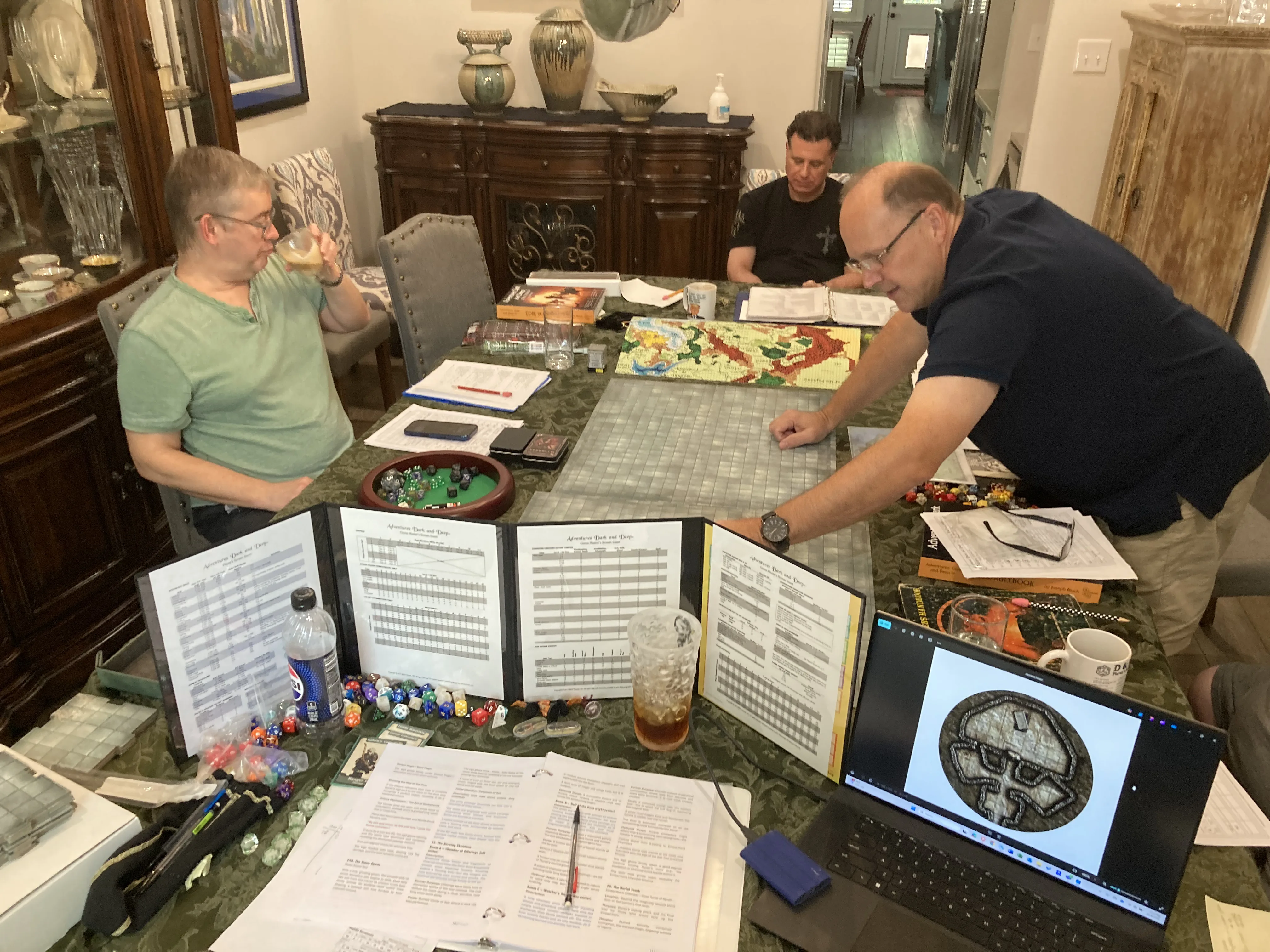
A Raven at Wreckshore
The message carried Vandy’s familiar mixture of excitement and irreverence. She wrote that something had surfaced among the deep stacks of the Hall of Illumination, something connected to the old map Hugo had previously left in her care. A symbol on a half-burned fragment matched one already present on Hugo’s map, and whatever the connection meant, Vandy considered it important enough to send a bird all the way to Wreckshore.
The party wasted little time. By the time the fog began to thin over the coast, Haldir Sorenson, Hugo Baudelaire, Galborn Valgwyn, Darrak Goldenforge, and Brother Merrick were on the road back toward Seaton’s Cove. The damp morning gradually gave way to broken clouds, and by midday patches of pale spring sunlight moved across the fields and hedgerows. Planting had brought new grass to the lowlands and buds to the trees, but the roads remained soft from recent rain, and wagon wheels had cut dark ruts through the shoulders.
At the Hall of Illumination, they found Vandy Banderdash surrounded by the evidence of several days’ work: books opened face-down across tables, loose parchment held flat beneath stones, and copied symbols scattered among notes in more than one language. The little librarian was plainly delighted to have found something obscure enough to justify the disorder.
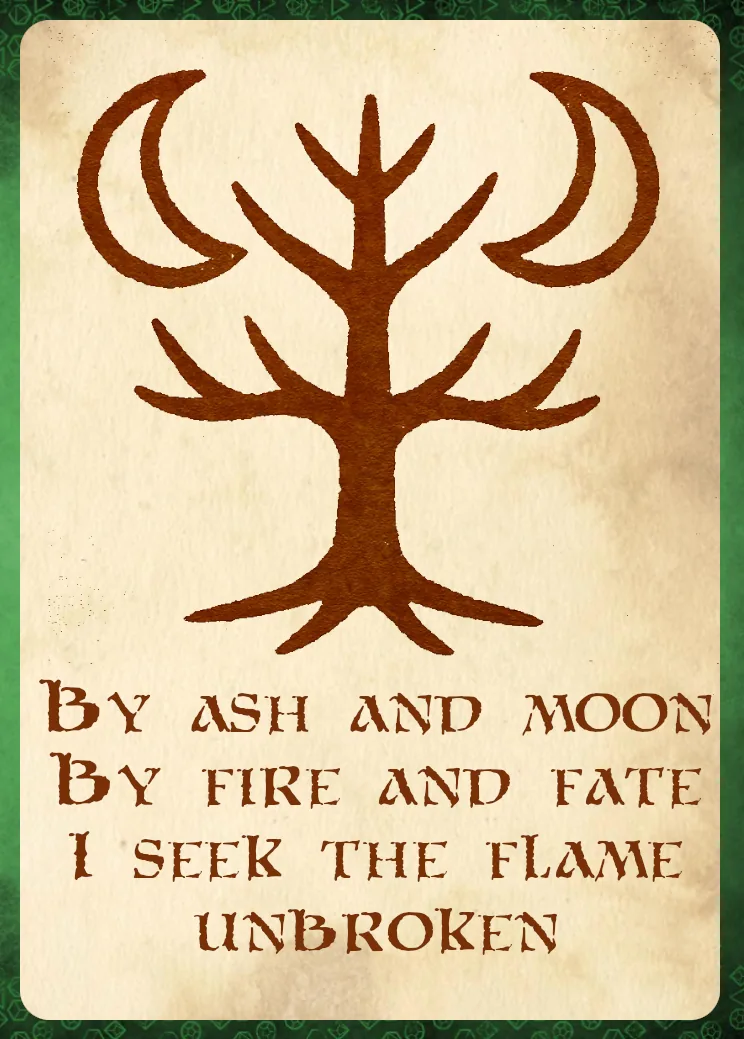
The fragment she showed them had been scorched along one edge, but the surviving portion bore a stylized ash tree beneath two waning moons. Vandy had compared it against Hugo’s map until there was no reasonable doubt that the symbols were the same. Beside it was a damaged line of Flannae script that she had reconstructed as best she could: in the ash-cursed grove where Nyzali’s arrow last burned… there lies the Emberthorn.
Nyzali of the Ash Tree, Vandy explained, belonged to the twilight of the Ur-Flan age. The surviving references described her as a huntress, a seer, and a wielder of fire, though time had reduced her story to fragments. The name Emberthorn was even more elusive. Vandy had found no reliable description of it, only the suggestion that whatever it was had been important enough to hide and important enough for someone else to remember centuries later.
The map offered one practical clue. The place marked by Nyzali’s sigil lay near Burle, in a region identified as Ashridge Hollow.
The party had begun the morning at their own hearth on Wreckshore. By afternoon they had a forgotten Flan name, an unknown relic, and a destination somewhere near the southern edge of the Dreadwood.
West Along the Coast
The route to Burle first carried them west along familiar roads. They passed through Seaton, where the fortified town rose above the coast, and continued along the Saltstone Road toward Saltmarsh. The spring weather remained unsettled. Sunlight would break through for an hour, warming the damp ground, only to vanish behind another bank of gray cloud rolling inland from the sea.
Late in the day they came upon a crossroads where a heavy merchant wagon had listed badly toward the ditch. Its left front wheel had splintered, leaving the axle low and the cargo dangerously unbalanced. Dwarven laborers had braced the wagon with timbers while a grim-faced overseer crawled beneath it to inspect the damage. Two mounted Keoish soldiers rode out to meet the adventurers before they came too close, hands resting near their weapons until the party made its peaceful intentions clear.
The wagon bore the mark of the Copperlocks Clan, a hammer crossed with a lantern burned into the rear panel. It was part of a guarded mine shipment, valuable enough that the soldiers had no intention of leaving it unattended on an open road. The dwarven overseer was less interested in conversation than in getting his cargo moving again, but when the party offered assistance his suspicion gave way to practical gratitude.
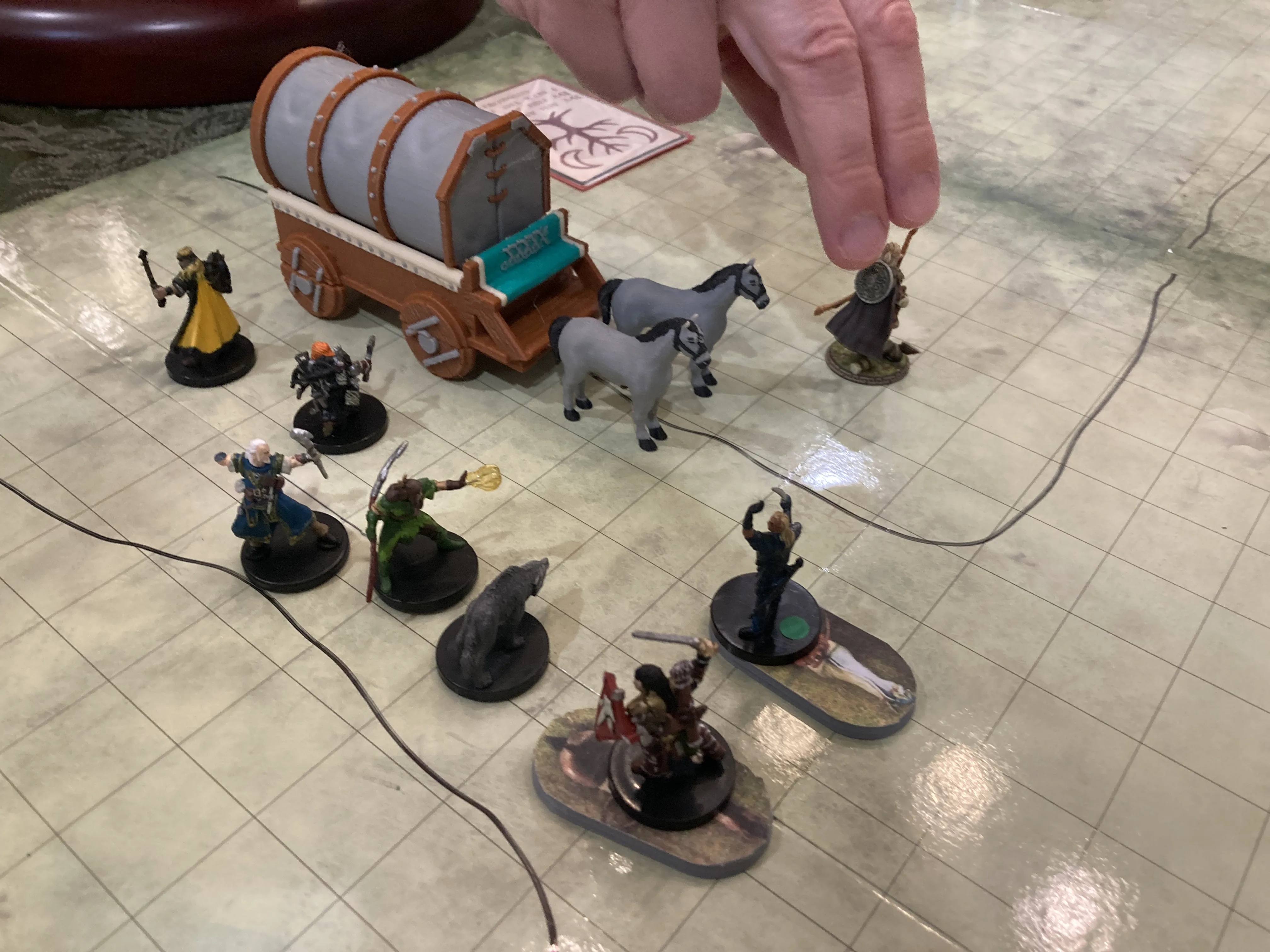
What followed was not heroic work, but it was necessary work. The wagon had to be lifted, the damaged wheel removed, braces reset, and a replacement fitted firmly enough to bear the weight of the load. Darrak Goldenforge understood the rhythm of such labor immediately, and even those less accustomed to wheels and axles could hold timbers, shift cargo, or keep the horses calm. By the time the final pin was driven home, sweat had replaced the morning chill and the wagon once again sat squarely on the road.
The overseer had just begun to thank them when hoofbeats sounded from the east.
Red Cloth on the Road
The riders appeared over the rise in patchwork armor with red cloth wrapped across their faces. They did not slow to assess the wagon or call for surrender. Weapons were already in their hands, and the way they spread across the road made it clear they had expected to find the shipment there.
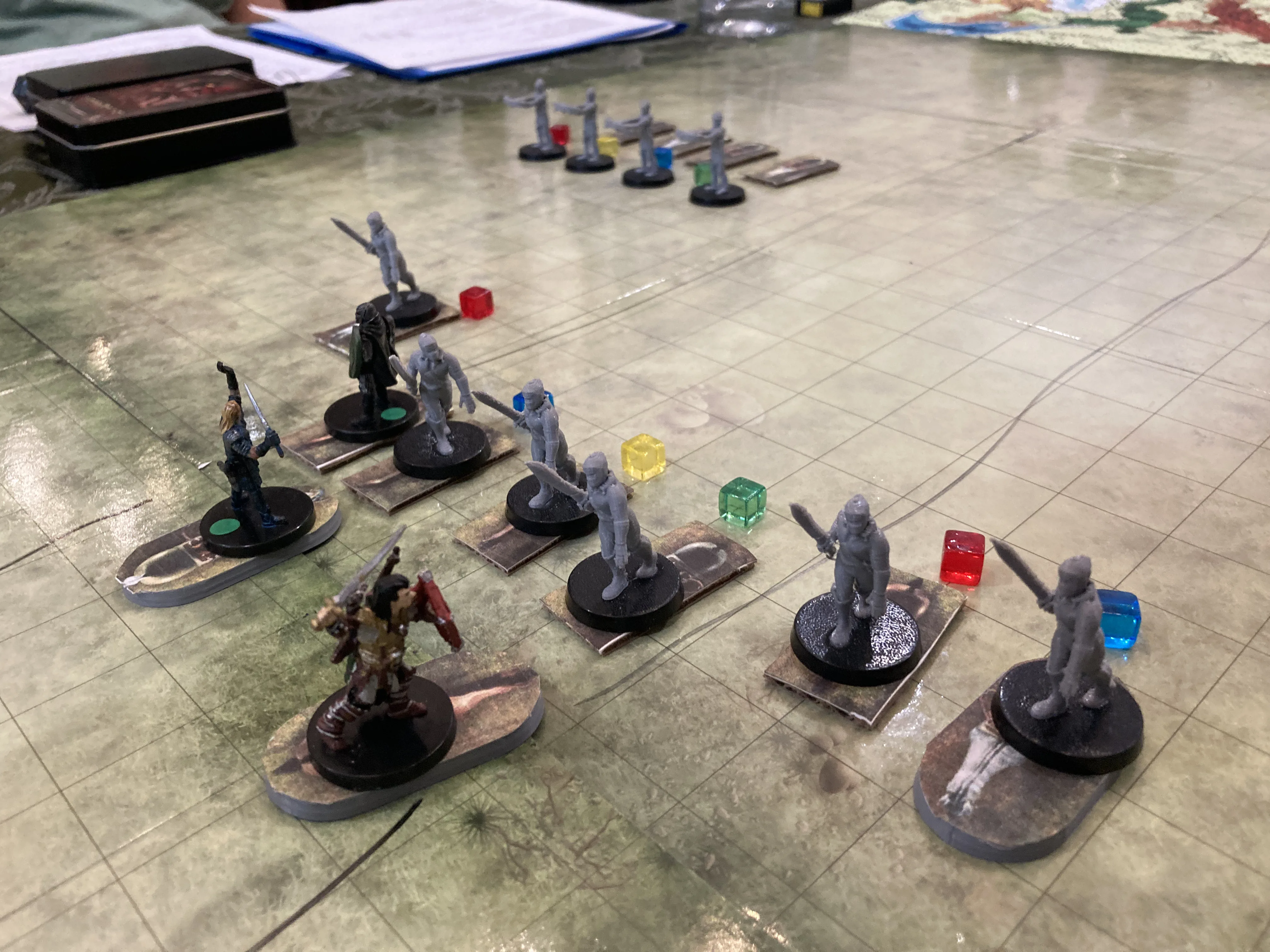
Haldir Sorenson reacted before the bandits could settle into their attack. Grass, weeds, and roadside growth twisted upward beneath several crossbowmen, wrapping around boots and legs as the raiders tried to dismount and spread out. Horses screamed and reared in the sudden tangle while the rest of the bandits pushed forward toward the wagon.
The Keoish guards met the first charge with spear and shield. Darrak Goldenforge moved to reinforce them, while Galborn Valgwyn, Hugo Baudelaire, and Brother Merrick fought to keep the attackers from reaching the laborers and the exposed cargo. The crossroads quickly filled with the noise of steel, frightened horses, shouted warnings, and the snap of crossbow strings from those bandits who managed to find clear lines of fire.
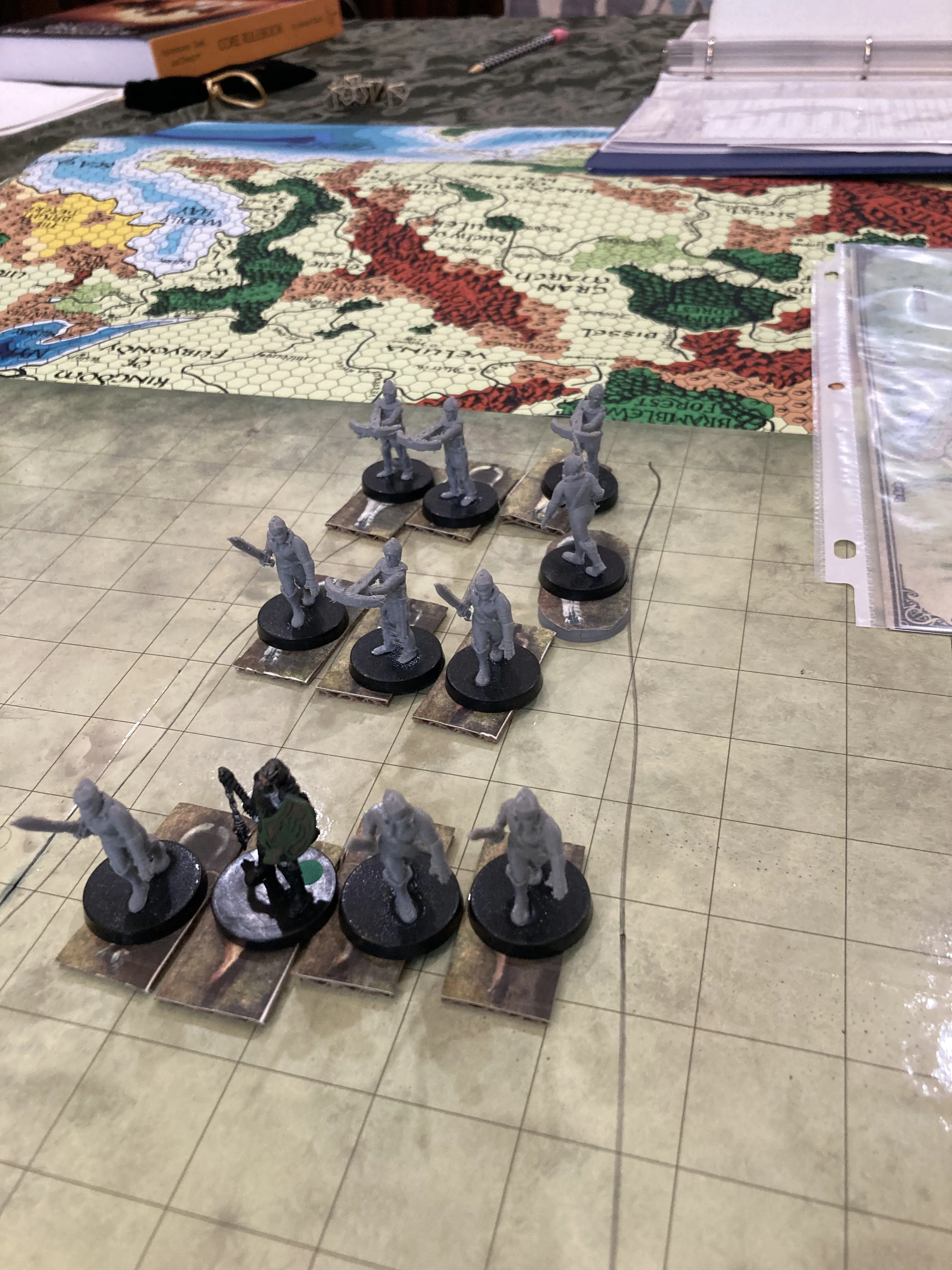
The ambush began to unravel once the attackers lost their momentum. Several fell in the road, and others broke away when it became clear that the supposedly vulnerable wagon was now defended by far more than two guards and a handful of laborers. The survivors fled rather than allow themselves to be surrounded.
One man ran in a different direction.
He had been among the wagon crew.
The sudden flight did not escape Haldir’s notice. His wolf picked up the man’s trail and followed it away from the road, eventually driving the fugitive into a position where he could be taken alive. Under Darrak’s questioning, the truth came out: the laborer had been feeding information to the bandits and had arranged the time and place of the attack.
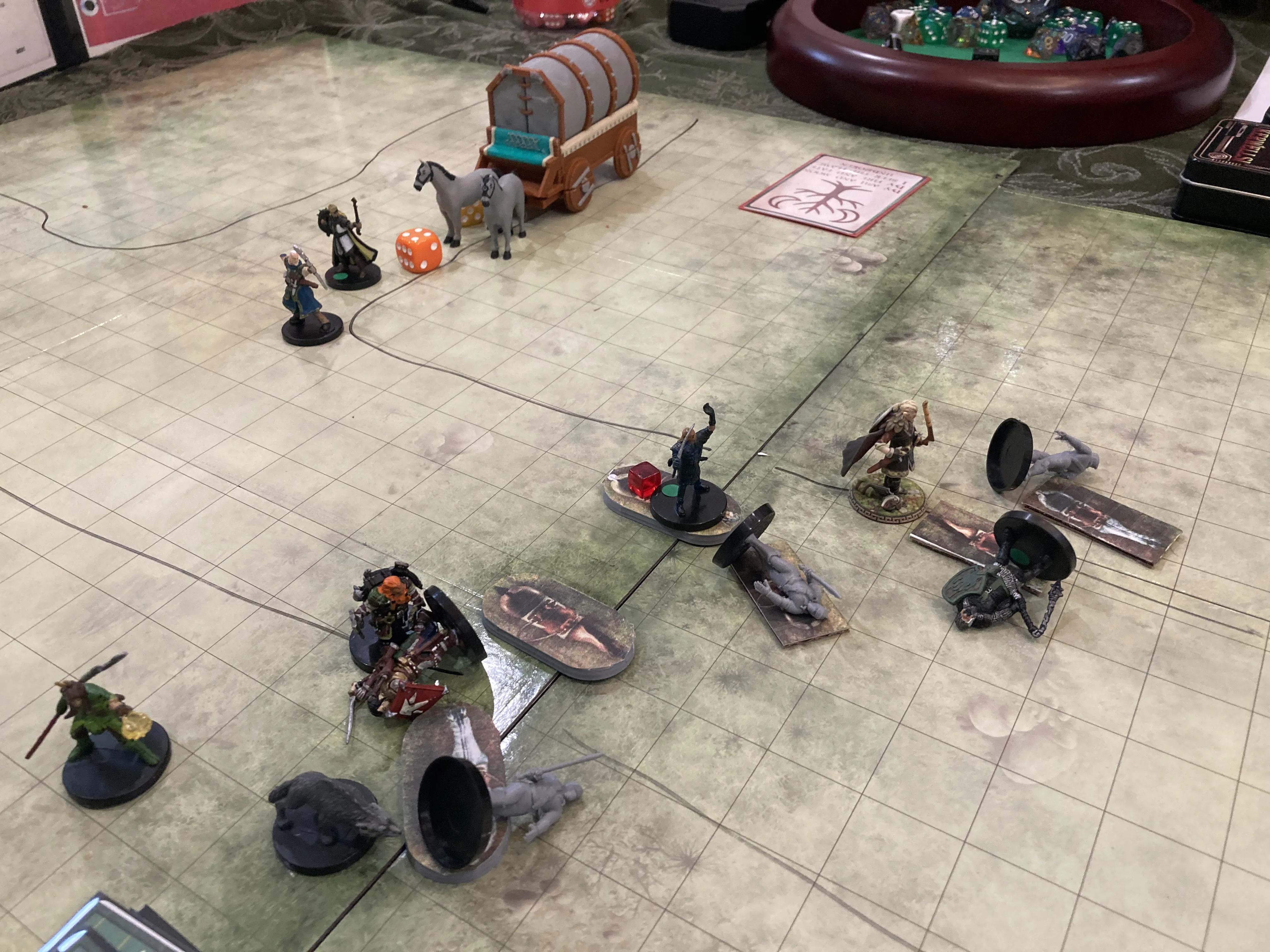
The Keoish guards thanked the party with the blunt sincerity of men who knew how badly the day might have gone without help. Word of the fight spread ahead of them, and by the time the party reached Saltmarsh, the roadwardens there had already heard enough to ask questions.
Saltmarsh and the Road Inland
Saltmarsh received them beneath low cloud and the smell of brine. Fishing boats rocked in the harbor beyond the town, gulls wheeled over the masts, and wet wind came in from the sea carrying the sharp scent of marsh and salt water. It was a place with one foot in honest trade and the other in older, less respectable habits, though on this evening most eyes were on the strangers arriving with a story already spreading ahead of them.
The party sold captured gear from the fight on the road. Curiosity followed them into the market, but suspicion eased when a burly watchman in a faded tabard caught sight of Darrak.
Sergeant Delmon “Ironhook” Bale knew Darrak Goldenforge.
The recognition transformed the encounter at once. Bale’s guarded expression broke into a grin as he clapped the dwarf on the shoulder and demanded to know what trouble had brought him to Saltmarsh. Once he heard about the attempted robbery and saw the captured gear, he helped make certain the sale was handled legally rather than leaving the party to explain a pile of bandit weapons to every merchant in the square.
The arms and armor were sold, along with the horses they did not intend to keep, and the local watch arranged lodging for the night. Saltmarsh had its own share of smugglers, raiders, and men willing to prey on travelers, and a party that had removed one such band from the road had earned at least a bed under a dry roof.
The rain returned after dark, tapping softly against the shutters of the inn while the town settled around them. Beyond the window, lanterns along the docks burned through a thin mist and reflected in the black water between the boats.
By morning, they were moving again.
Burle
The road from Saltmarsh toward Burle left the immediate coast and passed through rolling fields, scattered farms, damp lowlands, and stretches of woodland that grew thicker as the Dreadwood drew nearer. Spring was more obvious here than at Wreckshore. New leaves showed among the hedges, grasses had begun to climb the roadside banks, and runoff from the hills filled every ditch and narrow stream.
Burle appeared toward evening as a settlement built for defense first and comfort second. A stone keep dominated the hill above the town, with palisades and watchtowers commanding the approaches. Fields and clustered homes spread below it, and beyond the fortifications the first dark reaches of the Dreadwood gathered along the horizon.
The guards challenged the party at the gate, but before they had finished answering, a dwarven voice called down from the rampart.
Torvek Stonebeard remembered Darrak from years spent guarding caravans to Gradsul.
Their reunion was warm enough to draw smiles even from the gate guards. Torvek had already heard of the bandit attack; a raven from Saltmarsh had reached Burle ahead of them. He listened to the story with particular satisfaction when he learned that Darrak had helped uncover the inside man, then turned to the stranger question that had brought them so far west.
Torvek knew nothing of Nyzali, Emberthorn, or an ash-tree shrine, but the map itself was another matter. He recognized the course of the hills and rivers and pointed north toward the edge of the Dreadwood. If the map was accurate, the place they sought lay perhaps half a day’s march from Burle, just inside the forest.
Before leaving town, the adventurers also met Castellan Kiara Shadowbreaker. She received the report of the bandit attack with blunt approval, more interested in what the party had learned about the raiders than in ceremony. Kiara could add little about Ashridge Hollow itself; the deeper reaches of the Dreadwood lay outside the territory she directly controlled. She did, however, mention an archdruid named Ethyra, whose influence was said to extend through parts of the western forest.
The following morning, the party left Burle behind and turned north.
The Mad Hermit
The cultivated ground faded gradually. Farms gave way to open foothills and scattered woods, and then the woods thickened around the old trail. Haldir Sorenson took the lead once the route became uncertain, using the map, the shape of the hills, and his own Woodcraft to keep the party moving in the right direction.
The final stretch left the trail altogether.
Under the trees, the ground was dark with wet leaves and moss. The smell of fresh spring growth mingled with older scents of bark, fungus, and rain-soaked earth. Sunlight reached the forest floor only in broken patches, and the sounds of the road disappeared so completely that the party could hear water dripping from branches several yards away.
They found the hermit beside the remains of a stone shrine beneath a twisted ash tree.
At first, he seemed more a piece of the forest than a man. His robes were a patchwork of rags, his hair tangled with feathers and bits of bone, and his bare feet were black with mud. One eye was blue and alert; the other had clouded to a milky haze. He gripped a roughly carved staff and wore dozens of little charms made from bark, string, and animal remains.
He was muttering before the party spoke to him.
“Moon burns down, flame rises up. Roots remember. Roots never forget…”
His manner shifted unpredictably between laughter, solemn warning, and fragments of speech that seemed to belong to conversations no one else could hear. When the party asked about Nyzali, however, the nonsense briefly gathered into something almost lucid.
“Nyzali… Nyzali… Flame-mother, tree-sister. She burned and bled for the tribe. Buried herself to keep the fire safe. Burned the mouths of the hungry.”
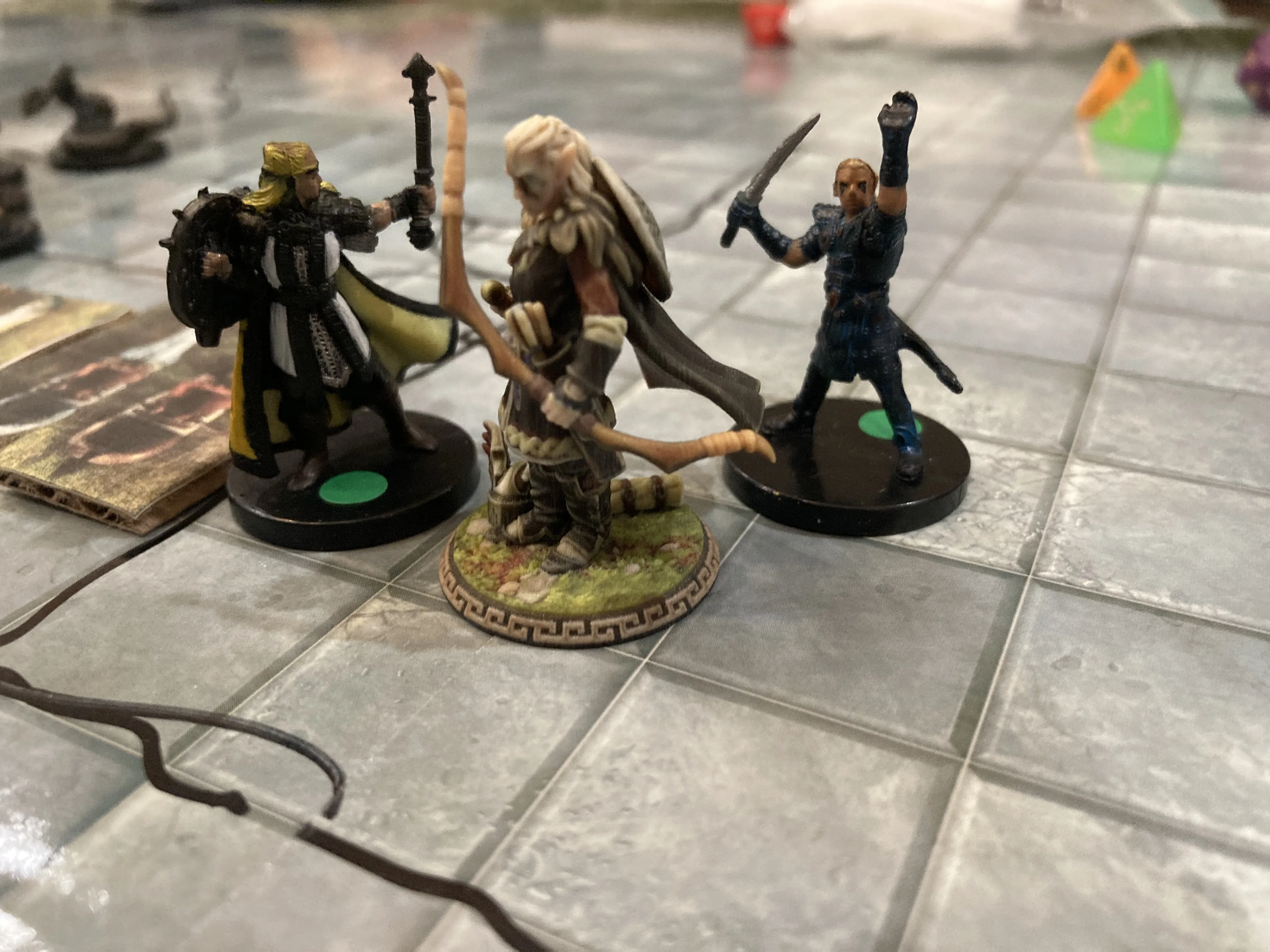
The moment passed as quickly as it had come, and his rambling grew worse afterward. Hugo Baudelaire, perhaps out of sympathy or simple curiosity, offered him food. The hermit accepted it eagerly and in return pressed a handful of crude forest charms into Hugo’s hand as though they were treasures of great importance.
Nothing about the encounter felt threatening enough to justify violence. The man was strange, certainly, and his words were unsettling, but he made no move against them and refused to accompany them toward the barrow.
The party continued north.
Ashridge Hollow
The forest changed before the barrow came into sight.
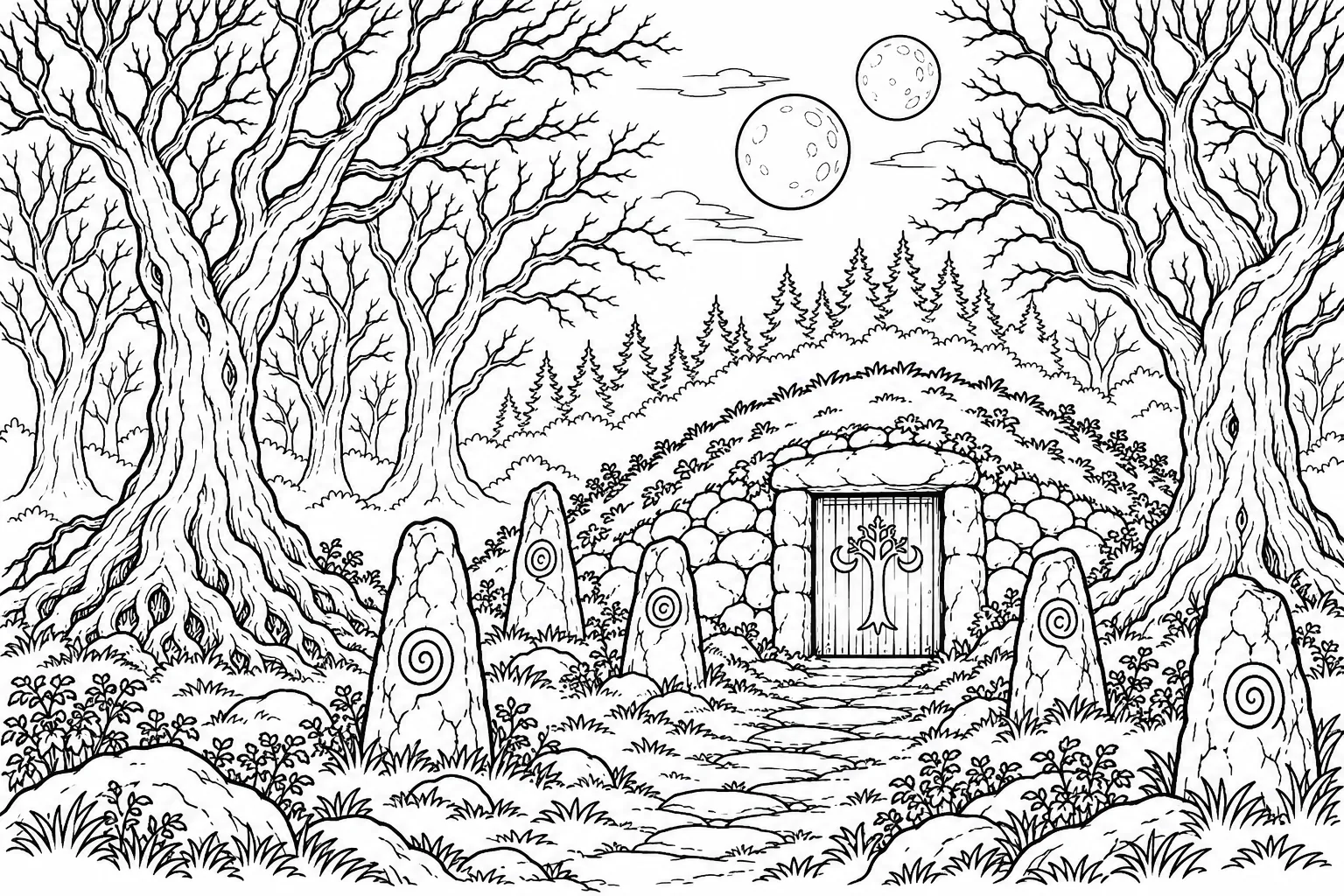
The living pines and spring growth thinned into a shallow hollow ringed by old stones and ash trees whose bark had faded almost gray. Many of the branches were bare despite the season, and others looked scorched at the tips, as though touched by a fire that had never fully consumed them. Moss-covered boulders broke through the leaf litter, and weathered standing stones leaned among the trees.
The stones were unmistakably ancient. Spiral carvings wound across their faces beside moon shapes and other Flan marks softened by centuries of rain. Several had split from top to bottom, not with the slow cracking of frost but with violent fractures that suggested force from within.
The silence was the most unsettling part.
There had been birds in the forest behind them. There had been squirrels in the branches, insects in the undergrowth, and the occasional movement of small animals through the leaves. Within Ashridge Hollow those sounds disappeared. Only the wind remained, slipping through the dead branches with a dry whisper.
At the far side of the hollow, built into a low grassy rise, stood the barrow.
The entrance was a stone face set directly into the mound and half-obscured by moss, roots, and lichen. Time had softened the carvings around it, but at the center the same symbol appeared again: an ash tree beneath two waning moons, traced in faded ochre.
The stone showed no hinges, no handles, and no visible seam by which it could be opened. When touched, however, the sigil carried a faint warmth. Hugo examined it with magic and confirmed that the mark still held power.
Darrak Goldenforge looked again at the map.
The words were there.
“By ash and moon, by fire and fate, I seek the flame unbroken.”
When the oath was spoken, warmth spread through the symbol. Ochre lines brightened against the stone, the seal shimmered, and the entrance yielded without being forced. Cool, dry air flowed from the darkness beyond, carrying the faint smell of old earth and charred wood.
The Barrow of Nyzali had opened.
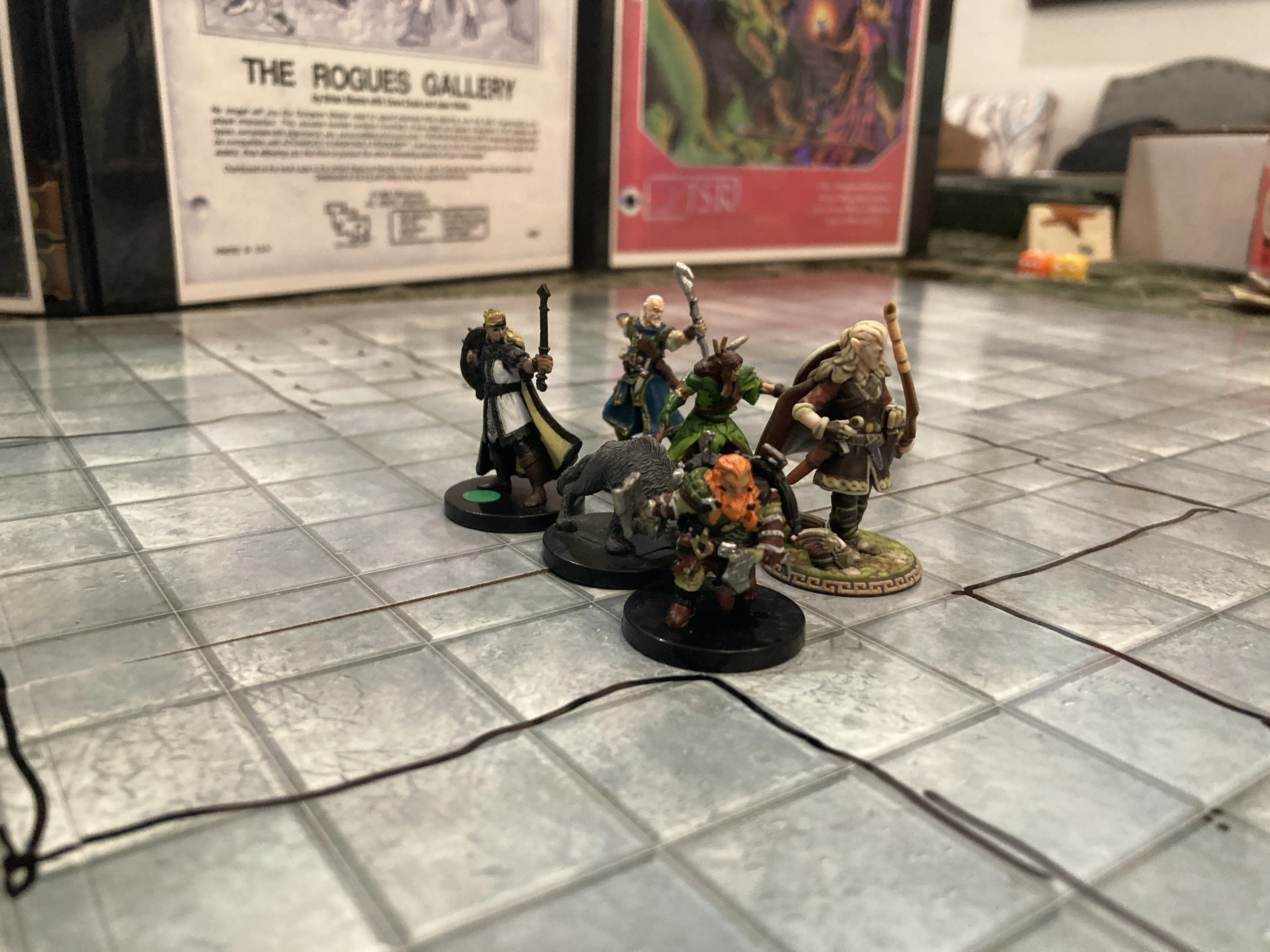
Beneath the Mound
The passage descended into fitted stonework. Unlike a rough tomb hacked from earth, the interior had been carefully constructed, though age and violence had marked it. Spiral carvings flowed along the walls like smoke, wind, and curling branches. Some had been cracked or blackened by heat. A faded mosaic covered part of the floor, showing a lone huntress with a burning bow surrounded by wolves, trees, and stars.
Two ancient doors led farther into the mound.
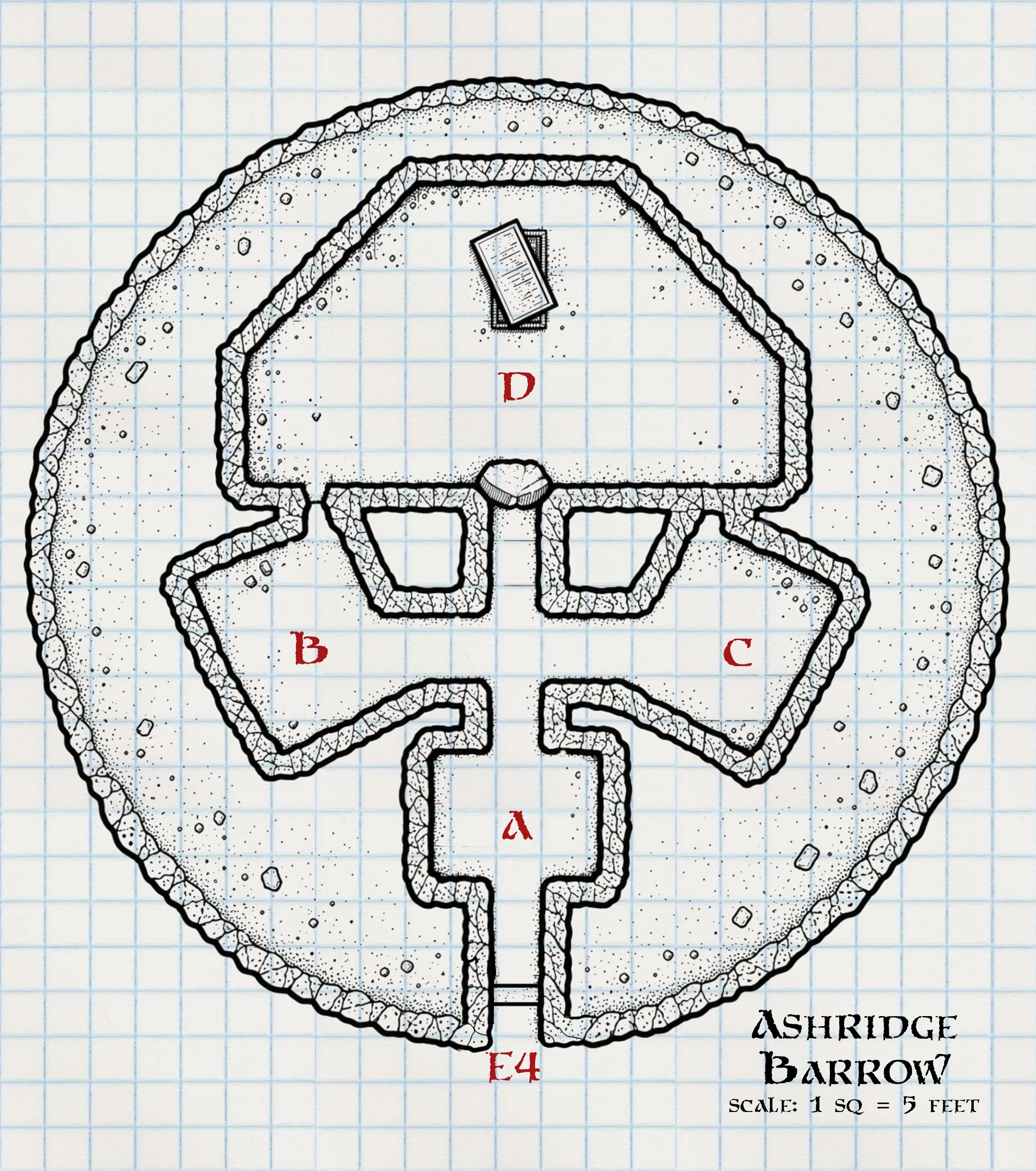
The party took the left-hand passage first. Beyond it lay a chamber that had once been a place of offering. Broken stone bowls littered the floor among fragments of charred wood, and soot-blackened murals showed hunters kneeling before a flaming tree. Claw marks and smoke had ruined much of the artwork, but enough remained to suggest reverence rather than fear in the original design.
One wall had been broken open.
The damage was crude compared with the fitted stone around it, leaving a dark breach leading into a larger chamber beyond. Whatever had made the opening had not bothered with the barrow’s intended doors.
Across the way, the right-hand chamber preserved another part of Nyzali’s story. Wolves ran beside a solitary huntress whose bow had been carved as a burning arc. Here too the images had been deliberately damaged. Faces had been scratched away, lines gouged through the figures, and bits of ash and bone remained along the edges of the room.
At the far wall stood a broken relief of Nyzali herself. Darrak examined it closely enough to discover a concealed panel behind the stone. Inside was a broken clay vessel holding reddish dust—the ashes of Nyzali’s sacred grove, preserved through all the years of desecration.
The party eventually returned to the inner door. Nyzali’s sigil marked it just as it had marked the entrance to the mound, and the same oath opened the way.
Beyond waited the burial chamber.
Fire in the Tomb
The door ground inward and released a wave of unnatural heat.
The chamber beyond was large and circular, its walls blackened by old fire. Runes that had once covered the stone were barely visible beneath soot and places where the surface itself seemed to have softened or melted. Against the far wall stood a raised stone bier or sarcophagus untouched by the destruction around it.
The rest of the room looked as though a battle had ended only moments before and then been abandoned for centuries. Charred bones lay scattered across the floor. Twisted fragments of metal had fused to stone. Scorch marks overlapped in dark rings, and near one side of the chamber a mound of cinders still smoldered faintly.
Then three separate flames sprang to life around the room.
The party did not wait to discover whether the chamber was about to erupt. The door was pulled shut, and they withdrew toward the entrance chamber, expecting the stone behind them to shake with an explosion.
None came.
Instead, movement sounded from the broken passage beside the chamber of offerings.
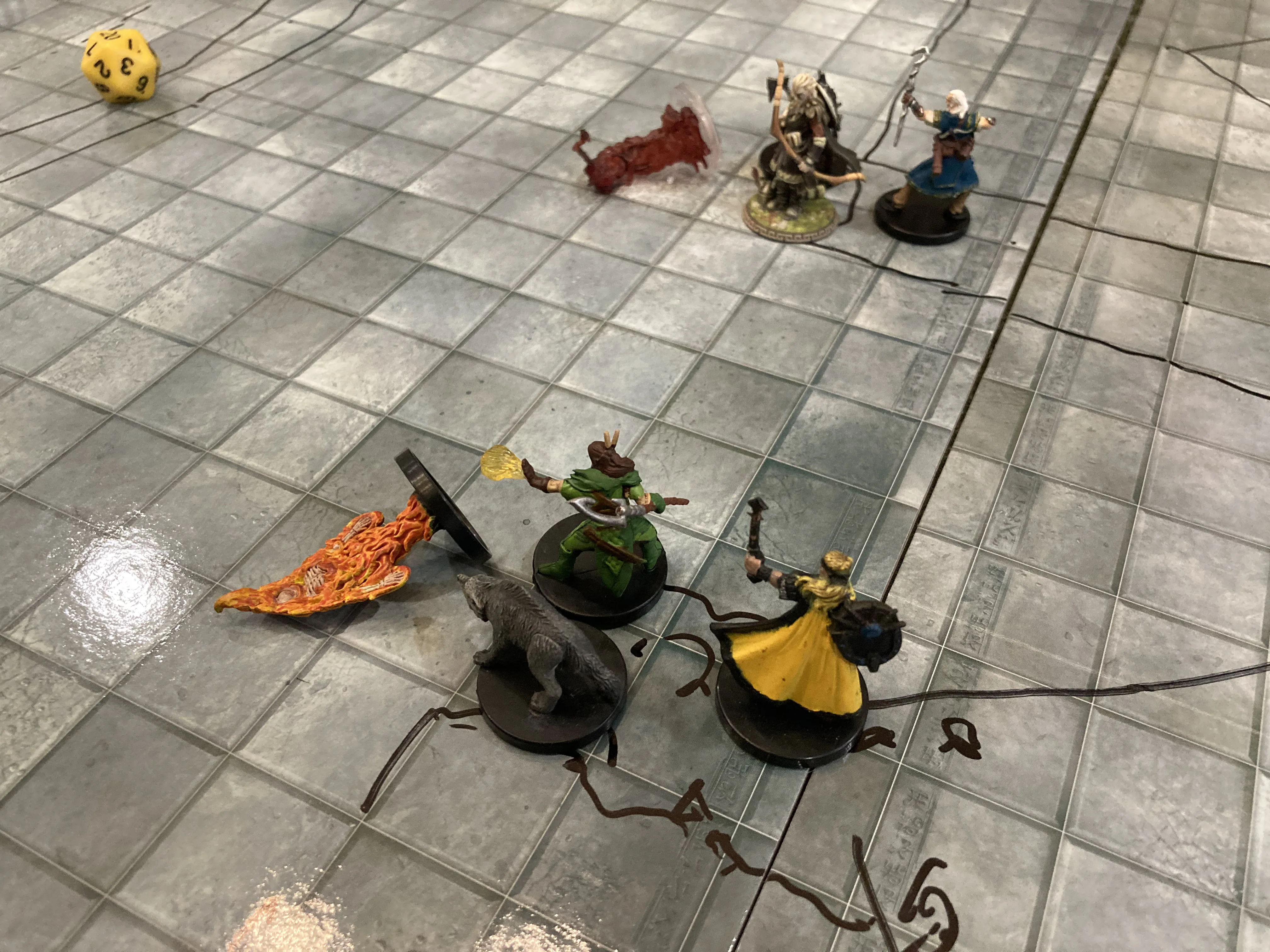
Two skeletons stepped from the darkness wrapped in living fire.
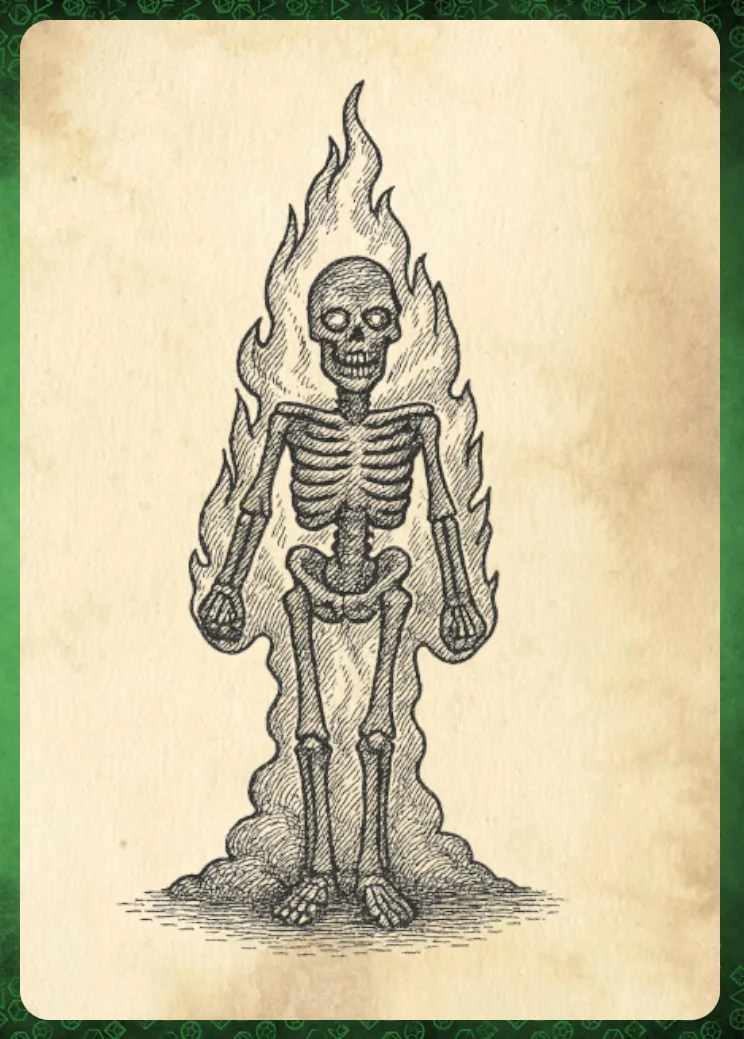
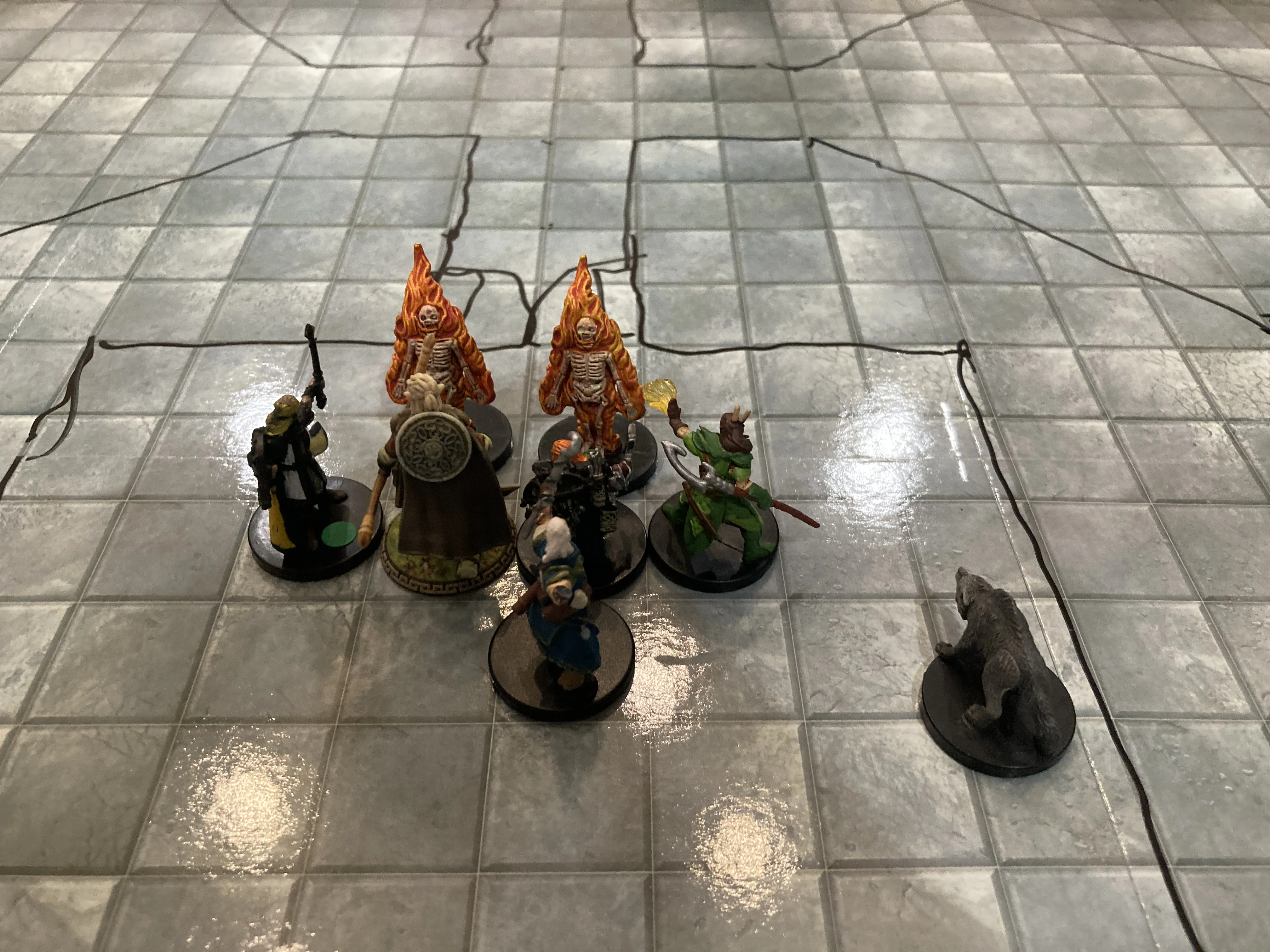
The heat struck before the creatures did. Those in the front rank felt exposed skin burn simply by standing close enough to fight. Swords and other edged weapons struck bone without the effect the party expected, forcing them to adjust quickly. Darrak Goldenforge abandoned the blade in favor of his war hammer, smashing through scorched ribs and joints with far greater effect. Galborn Valgwyn shifted his grip on his spear and used the shaft more like a staff, battering rather than cutting.
The burning skeletons lasted only a few rounds once the party understood what worked against them, but the fight left its mark. Armor was hot to the touch, clothing had been singed, and the corridor smelled of smoke and scorched leather. Brother Merrick tended the worst injuries while the others listened for movement from the tomb.
When they were ready, they went back.
This time the party divided its approach. Some held near the outer chambers while the others returned to the burial door and the broken passage. They entered cautiously, expecting another rush of flame.
A third burning skeleton attacked from the left.
At nearly the same moment, the smoldering mound of cinders in the burial chamber began to rise.
Ash rolled upward in a twisting column. Smoke thickened into the suggestion of shoulders and arms, and two points of coal-red light opened within a face that was barely more than a shape in the soot.
The Ember Grue had awakened.
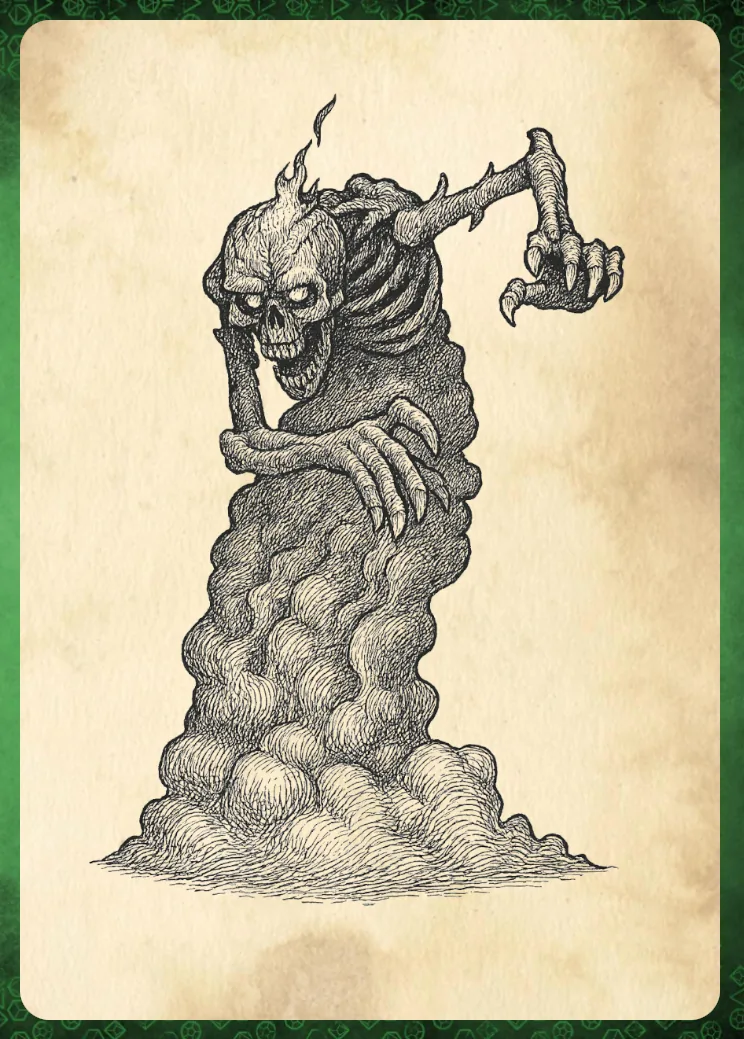
The creature advanced through a cloud of choking smoke that spread around it, making every breath near the doorway difficult. The skeleton pressed the attack from one side while the Grue tried to hold the narrow approach, forcing the party to fight in a place where numbers offered little advantage.
They held.
Blows struck through ash and fire. The skeleton fell first, and once the party could concentrate on the Grue, its smoky form began to tear apart under repeated attacks. It fought with the fury of something that had been trapped for a very long time, but it did not break the line.
When the last embers scattered across the floor, no member of the party had fallen.
The guardians of the tomb were gone.
Emberthorn
Silence returned slowly to the burial chamber. Smoke drifted toward the ceiling and thinned, revealing details the party had been unable to study during the fight. The scorched walls, broken remains, and ritual debris all spoke of violence that had happened long before their arrival, but the stone bier at the rear of the chamber remained strangely untouched.
Across its top lay a bow.
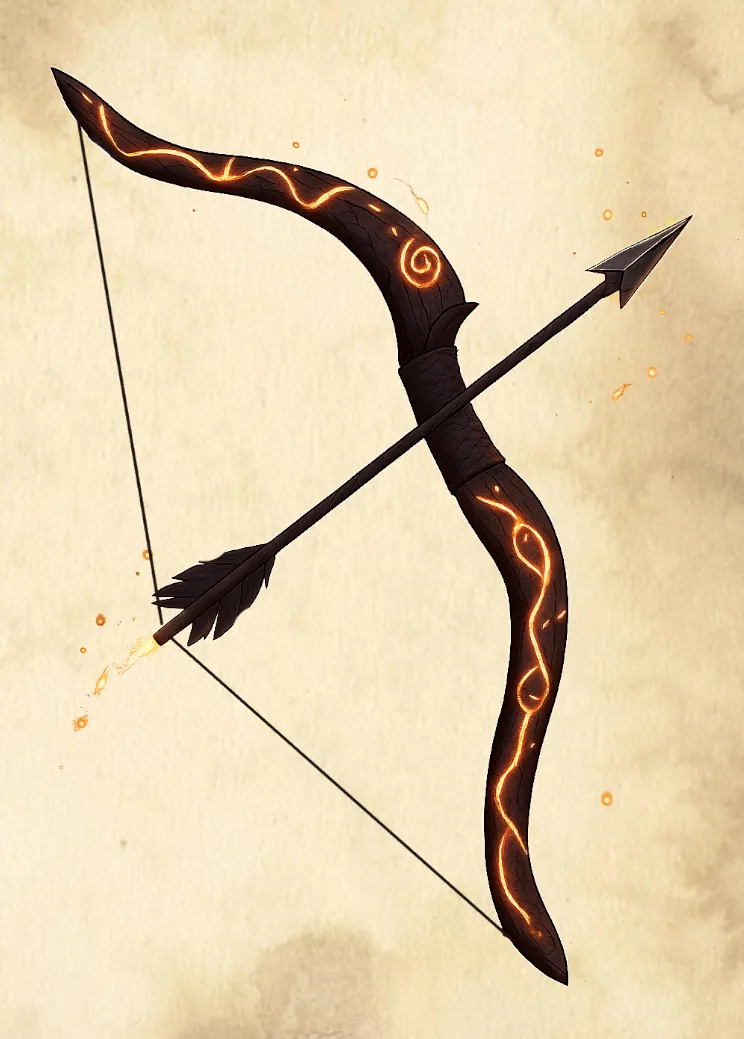
Emberthorn was fashioned from jet-black wood shot through with faint ember-colored veins. Spiral runes followed the curve of its limbs, some carved shallowly into the surface and others burned so deeply that they seemed part of the grain itself. The grip was wrapped in dark scaled hide, and the string had a glasslike sheen that caught the firelight without reflecting it normally.
The bow was not hot, yet it carried warmth.
Galborn Valgwyn reached toward it.
The change in the chamber was immediate. The lingering heat faded, the last drifting smoke settled, and a soft golden radiance appeared above the bier. Within it, the shape of a woman slowly formed—tall, cloaked in leaves and ash, a longbow resting across her back.
No words were spoken.
The apparition raised one hand in what seemed to be a blessing. With the other, she gestured first toward Emberthorn and then toward Galborn. For a few breaths she remained there, neither ghost nor living woman, her form wavering in the golden light.
Then she vanished like smoke carried away on the wind.
The scent she left behind was not ash.
It was wildflowers and firewood.
Galborn lifted Emberthorn from the bier.
What Nyzali Left Behind
The bow was not the only mystery in the tomb. The stone box beneath it appeared plain and seamless, with no obvious latch or hinge. Magic radiated from somewhere within, but finding a way to open it took patience and repeated examination.
Eventually Galborn discovered a concealed catch worked into the stone.
Inside was a funerary urn holding ashes, preserved from damp and decay, along with several objects that had survived in remarkable condition: a simple bronze circlet bearing two thin crescent moons, a hooded cloak woven from bark-fiber and char-cloth with Nyzali’s sigil worked into the lining, and a copper ring set with a warm orange stone.
The objects raised more questions than they answered. They were not arranged like ordinary treasure, and the presence of the urn made the chamber feel less like a vault than a place of remembrance. Whatever Emberthorn had become in the centuries since Nyzali’s death, this had first been her tomb.
Haldir Sorenson remembered the reddish ashes recovered from the hidden alcove in the outer chamber. Rather than carry them away as another curiosity, he suggested returning them to the burial box.
The party agreed.
The ashes of Nyzali’s sacred grove were placed with the remains inside. The box was closed again, and the adventurers did what they could to leave the tomb more secure than they had found it. Darrak blocked the crude breached passage through the side of the chamber, and the party used the same ancient words to close first the inner tomb and then the entrance to the barrow itself.
The ochre sigil faded.
Stone once again concealed the dead.
They left Ashridge Hollow carrying Emberthorn, but not as plunder taken from a forgotten grave. The vision in the burial chamber had made the distinction difficult to ignore: something within the barrow had permitted Galborn to take the bow.
The Hermit Unmasked
The walk back toward the horses began beneath the same strange quiet that had surrounded the hollow when they arrived. The barrow disappeared behind the trees, and ordinary forest sounds slowly returned as the party moved away from the standing stones.
Then a familiar voice drifted from the right side of the trail.
“Flame that walks, flame that watches. Her arrow still burns beneath the bones.”
The words stopped them.
A second phrase followed, quieter and less rambling than before.
“Two faces, two fates. One burns; one bleeds. But neither forgives…”
The party turned toward the voice just as reptilian humanoids rushed from the undergrowth.
They came fast and close, their bodies carrying a nauseating stench strong enough to weaken anyone caught near them. The attack was not the confused aggression of beasts. It was an ambush, timed for the moment when the adventurers were leaving the barrow with Emberthorn.
Then Galborn Valgwyn felt a blade strike from behind.
The man who attacked him resembled the hermit they had fed only hours earlier, but the resemblance ended with his face. His tangled hair had been roughly shaved away. The rags were gone, replaced by leather armor, and the carved walking staff had been exchanged for a short sword held with the confidence of someone who knew exactly how to use it.
Whatever madness they had witnessed beneath the ash tree, it had not been the whole man.
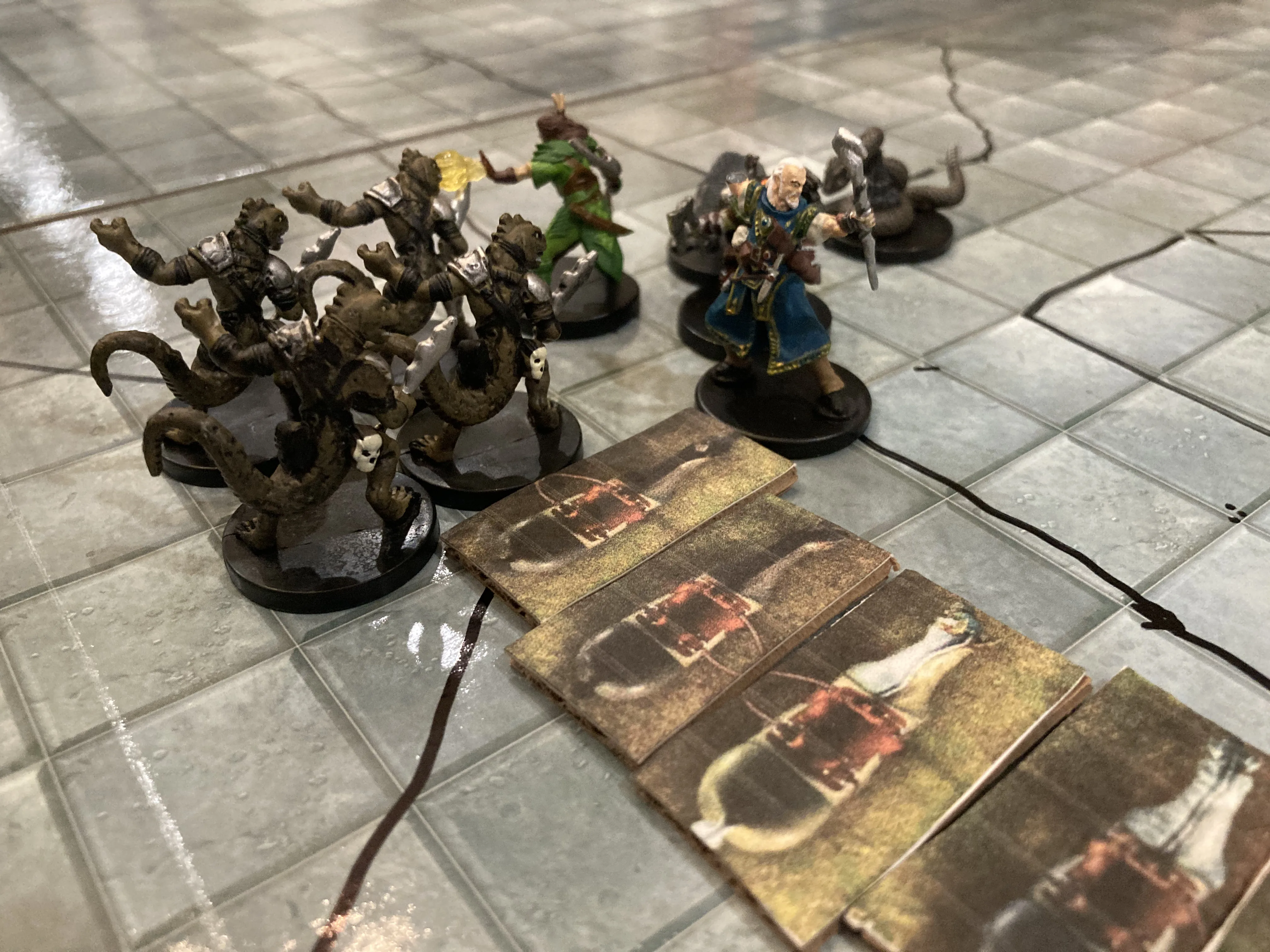
The fight lasted only a few rounds. The reptilian attackers were cut down, and the changed hermit fell with them. No one in the party was lost, but the encounter cast everything he had said earlier in a new light.
They returned to the great hollow oak where he had been living. Beneath the crude bed and makeshift furniture, the party found a strongbox that had been dug up from the floor.
It stood open.
The discovery suggested preparation rather than sudden madness. The hermit had known enough to retrieve whatever he had hidden there before following them, and he had waited until Emberthorn was out of the barrow before making his move.
The road back to Wreckshore now carried a different weight. Galborn possessed Emberthorn, but the bow had already drawn the attention of someone willing to kill for it. The Barrow of Nyzali had answered one question—what Vandy’s map had been pointing toward—but in doing so it had opened several more.
For the first time in centuries, Emberthorn was no longer resting beneath Ashridge Hollow.
It was traveling with them.
Comments