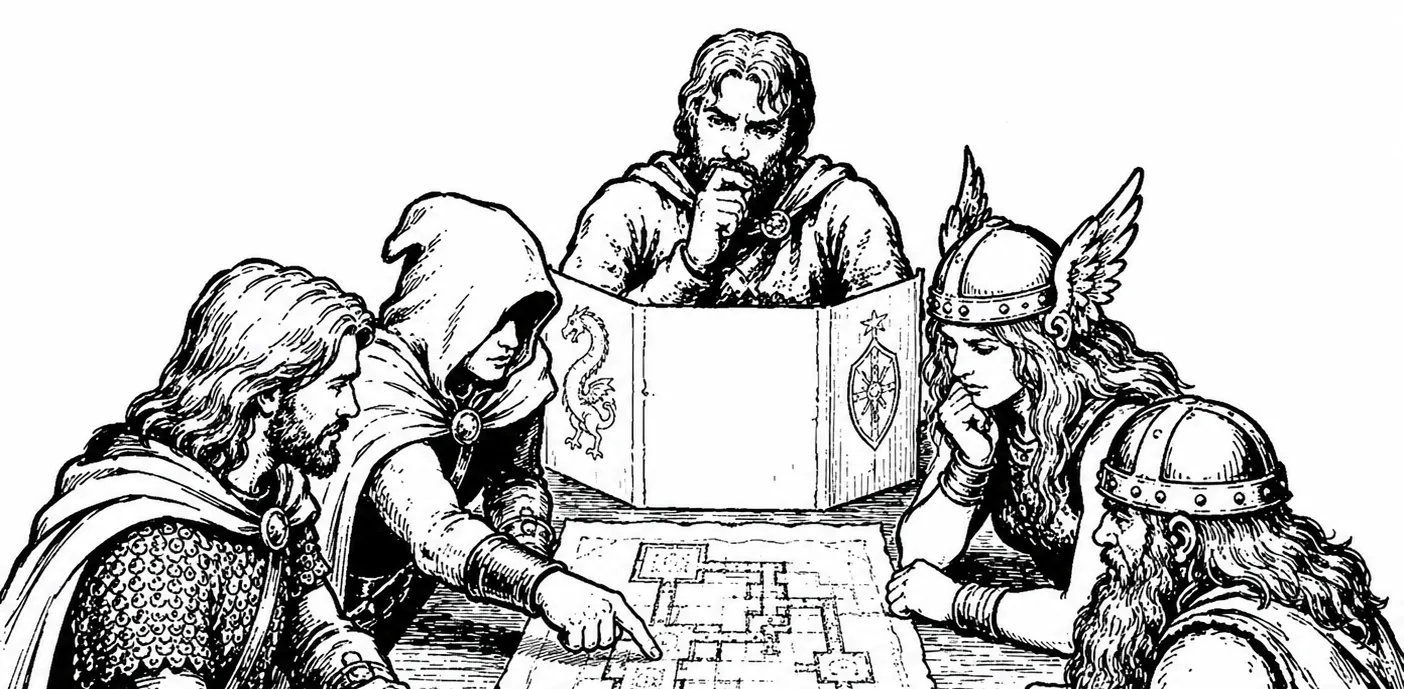
“The OSR is not a single game. It is a shared philosophy built on exploration, challenge, and imagination.”
What Is the OSR?
The Old School Renaissance, often shortened to OSR, is a movement within the tabletop role-playing hobby dedicated to preserving, exploring, and expanding the style of fantasy gaming that emerged during the first decade of Dungeons & Dragons.
Despite the name, the OSR is not a single game, company, or organization. It is a community of players, referees, writers, artists, and publishers who share an appreciation for the traditions of early role-playing games and continue to build upon them today.
The letters “OSR” have been interpreted in several ways over the years. Some gamers use Old School Renaissance, emphasizing the continued growth of classic gaming. Others prefer Old School Revival, highlighting the return of older styles of play. Still others use Old School Rules, focusing on the game mechanics that defined the early hobby. While the terminology varies, the central idea remains the same.
The OSR celebrates a style of gaming that values exploration, player ingenuity, meaningful risk, and open-ended adventure. Rather than following a predetermined story, players are encouraged to make their own choices, pursue their own goals, and discover the world through play.
One of the defining characteristics of the OSR is that it is both backward-looking and forward-looking at the same time. Many participants continue to play the original games published in the 1970s and 1980s. Others create entirely new adventures, campaign settings, rules systems, and tools inspired by those classic designs. The result is a hobby that honors its roots while continuing to evolve.
Today, the OSR includes thousands of players around the world. Independent publishers release new adventures every year. Online communities share ideas, maps, monsters, and campaign journals. New gamers continue to discover the appeal of old-school play, while veterans return to the style that first introduced them to the hobby.
More than a set of rules, the OSR is a shared philosophy of adventure—one that continues to inspire players more than fifty years after the publication of the original game.
Common Themes of OSR Play
While OSR games encompass a wide variety of rules systems, campaign settings, and design philosophies, they share a number of fundamental ideas that define the old-school approach to fantasy role-playing. These themes are not rigid requirements, nor will every campaign emphasize them equally. Instead, they represent the principles that have shaped the hobby since its earliest days and continue to influence players, referees, and game designers around the world.
More than any particular set of mechanics, the OSR is defined by the experience it seeks to create. Exploration is rewarded, ingenuity is valued, risk is meaningful, and the world exists independently of the player characters. Adventures unfold through the choices of the players rather than the expectations of the rules, creating stories that emerge naturally from discovery, triumph, and occasional failure.
This shared philosophy is what unites an incredibly diverse collection of games. Some players prefer the original editions published decades ago, while others choose modern systems inspired by those classics. The rules may differ in presentation and complexity, but they continue to embrace many of the same ideas that defined the earliest days of the hobby.
Rather than assuming every obstacle is meant to be overcome through combat or every challenge solved by a character ability, OSR games encourage players to observe, experiment, negotiate, and adapt to an unpredictable world. Success is earned through planning, resourcefulness, and a willingness to accept meaningful consequences when fortune turns against the party.
The following themes appear throughout the OSR regardless of the specific rules being used. Together they create a style of play that feels distinct from many modern role-playing games while remaining just as capable of producing memorable heroes, legendary campaigns, and unforgettable adventures. They are not rules that every table must follow, but common threads that continue to unite a community of players more than fifty years after the birth of fantasy role-playing.
Exploration First
One of the defining characteristics of OSR games is their emphasis on exploration. While combat, character development, and storytelling all play important roles, exploration often serves as the foundation upon which the rest of the game is built.
In many modern role-playing games, adventures are structured around a series of encounters designed to advance a story. OSR games frequently take a different approach. The world itself becomes the focus. Forgotten ruins, unexplored wilderness, ancient tombs, and mysterious locations are not simply backdrops for adventure. They are the adventure.
This emphasis on discovery encourages a sense of curiosity and wonder. Players are presented with places to investigate, secrets to uncover, and mysteries to solve. The question is often not “How do we defeat the next challenge?” but rather “What will we discover if we continue?”
As a result, exploration becomes more than movement across a map. It is a process of learning about the world, uncovering its history, and revealing opportunities that might otherwise remain hidden. Whether descending into an unknown dungeon or following a rumor into the wilderness, the act of discovery itself becomes one of the primary rewards of play.
This focus on exploration remains one of the most recognizable features of the OSR and continues to influence the design of adventures, campaign settings, and entire game systems throughout the movement.
Player Skill Over Character Skill
Another defining characteristic of the OSR is its emphasis on player ingenuity rather than character abilities. While character statistics, classes, and equipment certainly matter, they are intended to support creative thinking rather than replace it.
Many modern role-playing games rely on an extensive list of skills and abilities that determine what a character can accomplish. OSR games generally place greater importance on the decisions made by the player sitting at the table. Observation, planning, negotiation, experimentation, and problem-solving become as valuable as any entry on a character sheet.
This philosophy encourages players to engage directly with the game world instead of searching for a rule or special ability to overcome every obstacle. Challenges are often open-ended, allowing multiple solutions and rewarding clever ideas that the rules may never have anticipated.
As a result, success in an OSR game is measured not only by the abilities of the characters but also by the imagination and resourcefulness of the players themselves. Every expedition becomes an opportunity to outthink a problem rather than simply out-roll it, creating a style of play where creativity is one of the most powerful tools at the table.
Rulings Over Rules
Closely related to player ingenuity is another principle that has long defined the OSR: rulings over rules. Rather than attempting to provide a written rule for every possible situation, OSR games rely on the referee to interpret the circumstances and make a fair decision based on the needs of the moment.
This philosophy recognizes that role-playing games are limited only by the imagination of the people at the table. No rulebook, regardless of its size, can anticipate every question, plan, or unexpected solution that players might devise. Instead of interrupting the game to search for a specific mechanic, the referee is encouraged to make a reasonable ruling and allow the adventure to continue.
This approach places flexibility above strict procedure. Different referees may handle the same situation in different ways, yet both rulings can be equally valid if they are consistent, impartial, and support the shared experience of the group. The rules remain an important foundation, but they are viewed as tools to facilitate play rather than limitations that define it.
For many players, this freedom is one of the most appealing aspects of the OSR. It creates an environment where creativity is rewarded, unexpected ideas are welcomed, and memorable moments arise naturally from the interaction between players, referee, and the world they explore.
Meaningful Risk
OSR games embrace the idea that adventure should involve genuine uncertainty. The world is not carefully balanced around the abilities of the player characters, and success is never assumed simply because an encounter appears before them.
An ancient dragon may inhabit the first level of a dungeon. A band of goblins might prove far more dangerous than expected. Wandering monsters, hostile environments, and unexpected discoveries can quickly turn a promising expedition into a desperate retreat. The possibility of failure is not viewed as poor design but as an essential part of the experience.
This philosophy is also reflected in the rules themselves. Low-level characters are often fragile, resources are limited, and a single poor decision or unlucky roll can have lasting consequences. Character death is not uncommon, particularly during the early stages of a campaign. Rather than diminishing the experience, this danger reinforces the importance of careful planning, teamwork, and thoughtful decision-making.
As a result, players are encouraged to evaluate situations rather than assume every encounter is meant to be overcome through combat. Negotiation, deception, stealth, or simply running away are often the wisest choices available. Learning when not to fight becomes as important as knowing when to draw a sword.
This constant sense of risk gives weight to every decision. Treasure recovered from a dangerous ruin feels earned because survival was never guaranteed, and a character who reaches higher levels carries a history of close calls, difficult choices, and hard-won victories. In the OSR, meaningful risk is not an obstacle to enjoyment, it is one of the defining qualities that makes success so satisfying.
The World Exists Beyond the Characters
Many modern role-playing games are designed around the assumption that the player characters are the central figures of the story. Adventures are often structured to match their abilities, and encounters are frequently balanced to provide exciting but achievable challenges.
OSR games often take a different approach. The campaign world exists independently of the adventurers, following its own history, politics, and conflicts regardless of whether the players become involved. Ancient dragons continue to rule forgotten valleys, armies march across distant kingdoms, and rival adventuring parties pursue their own ambitions without regard for the heroes’ presence.
This philosophy creates a world that feels larger than the player characters themselves. A rumor about an abandoned fortress does not imply that the party is ready to explore it, nor does every mysterious cave contain opponents appropriate for their experience. Some places are meant to be investigated later, while others may be better avoided altogether.
Because the world is not built around the characters, player choice becomes increasingly important. Deciding where to travel, which opportunities to pursue, and when to retreat can have a greater impact than any single battle. The campaign develops naturally as the players leave their mark upon a living world rather than progressing through a story designed specifically for them.
For many players, this sense of independence is one of the defining strengths of the OSR. The world feels ancient, unpredictable, and full of possibility, inviting exploration without ever promising success.
The Major OSR Games
The Old School Renaissance is united more by philosophy than by a single set of rules. While players may disagree about which game best captures the old-school experience, they generally share an appreciation for exploration, meaningful risk, referee judgment, and open-ended adventure.
Over the past two decades, dozens of games have been published that embrace these ideas. Some are faithful recreations of classic rule sets, others refine and reorganize older mechanics, and still others introduce new concepts while remaining firmly rooted in old-school traditions. Together they form a diverse community of games that continue to inspire players around the world.
The following systems represent some of the most recognizable and influential titles within the OSR. Each offers its own interpretation of classic fantasy role-playing while remaining connected by the principles that define the movement.
The Original Games
Unlike many gaming movements, the Old School Renaissance is not limited to newly published rules systems. For many players, the simplest way to experience old-school gaming is to play the original games themselves.
More than fifty years after the publication of the first boxed set, countless groups continue to gather around the table using the rules written during the formative years of the hobby. Some prefer the simplicity of the original 1974 edition, while others enjoy the expanded options of Advanced Dungeons & Dragons or the streamlined approach of the Basic and Expert boxed sets. Each version offers a distinct interpretation of fantasy role-playing while sharing the same spirit of exploration, discovery, and player-driven adventure.
The original Dungeons & Dragons introduced the concepts that would shape the entire hobby. Its rules are concise, flexible, and often rely on the imagination and judgment of the referee. Many players appreciate its openness and simplicity, viewing it as a toolkit rather than a complete system.
The Holmes Basic Set provided an accessible introduction for new players, presenting a clear and inviting path into the world of fantasy role-playing while remaining compatible with the original game. For many gamers, it was their first experience with dungeons, dragons, and polyhedral dice.
The Moldvay/Cook Basic and Expert Sets, commonly known as B/X, refined those ideas into a remarkably elegant rules system. Praised for its clarity and ease of play, B/X remains one of the most influential versions of the game and continues to inspire both players and modern designers.
The Mentzer Basic, Expert, Companion, Master, and Immortal Sets expanded the Basic line into a complete game capable of supporting characters from humble adventurers to rulers of kingdoms and, eventually, immortal beings. Its presentation introduced an entire generation of players to the hobby and remains one of the most recognizable boxed sets ever published.
Advanced Dungeons & Dragons First Edition embraced a different philosophy, providing a wealth of classes, monsters, spells, and campaign options that encouraged referees to create expansive fantasy worlds. For many enthusiasts, it represents the classic expression of old-school role-playing and continues to serve as the foundation for countless campaigns.
Even Advanced Dungeons & Dragons Second Edition, while introducing a more organized presentation and a different emphasis in design, retains many of the assumptions and play styles that define old-school gaming. Many OSR players continue to enjoy Second Edition campaigns, demonstrating that the movement is united more by philosophy than by a single rules set.
Each of these games offers its own strengths and personality. Some emphasize simplicity, others depth and variety, while still others excel as introductions for new players. The diversity of these classic systems is one of the reasons the OSR continues to thrive, allowing every group to choose the version that best matches its own style of adventure while remaining connected to the shared traditions that began the hobby.
Modern OSR Games
One of the greatest strengths of the Old School Renaissance is that it is not limited to the games of the past. Over the last two decades, independent designers and publishers have created a remarkable variety of new systems inspired by the earliest days of fantasy role-playing. Some faithfully recreate classic rules, others reorganize and clarify them, and still others blend old-school philosophy with modern game design.
Together, these games demonstrate that the OSR is not simply about preserving history—it is an active and growing movement that continues to welcome new players while inspiring new adventures.
OSRIC (2006)
The publication of OSRIC (Old School Reference and Index Compilation) marked a turning point for the hobby. By presenting the mechanics of First Edition fantasy role-playing in an organized reference format, OSRIC provided a common foundation for independent publishers to create adventures and supplements compatible with classic play. Many historians of the hobby consider it the spark that ignited the modern OSR publishing movement.
Labyrinth Lord (2008)
Inspired by the Moldvay/Cook Basic and Expert rules, Labyrinth Lord quickly became one of the defining games of the early OSR. Its familiar mechanics, accessibility, and strong third-party support made it a favorite among players looking for a straightforward old-school experience.
Swords & Wizardry (2008)
Designed as a modern interpretation of the original 1974 rules, Swords & Wizardry embraces simplicity and referee flexibility. By stripping away unnecessary complexity, it captures the open-ended spirit of the earliest fantasy campaigns while remaining approachable for new and experienced players alike.
Basic Fantasy RPG (2006)
One of the most accessible games in the movement, Basic Fantasy RPG combines classic mechanics with modern presentation and an open publishing philosophy. Available as a free download and supported by an active community, it has introduced countless players to old-school gaming and remains one of the easiest entry points into the OSR.
White Box: Fantastic Medieval Adventure Game (2017)
Drawing inspiration from the original boxed set, White Box: Fantastic Medieval Adventure Game presents an elegant and approachable version of early fantasy role-playing. Its clean organization and minimalist design make it especially appealing to players seeking a simple but highly flexible rules system.
Old-School Essentials (2019)
Often regarded as the definitive presentation of the classic Basic/Expert rules, Old-School Essentials reorganizes every rule with exceptional clarity while remaining completely faithful to the original mechanics. Its outstanding layout, beautiful production values, and extensive line of supplements have made it one of the most influential OSR games published in recent years.
Adventures Dark & Deep™ (2022)
Rather than recreating an existing edition, Adventures Dark & Deep™ explores an intriguing question: what direction might Advanced Dungeons & Dragons have taken had Gary Gygax remained at TSR? Building upon the foundations of First Edition while introducing expanded options and new ideas, it offers a familiar yet distinct old-school experience that appeals to players seeking both tradition and innovation.
Shadowdark RPG (2023)
One of the newest and fastest-growing games in the movement, Shadowdark RPG blends classic dungeon exploration with streamlined modern mechanics. Real-time torch tracking, dangerous encounters, and an emphasis on player ingenuity create an experience that feels unmistakably old-school while remaining highly accessible to contemporary audiences. Its success has introduced a new generation of players to the principles that have defined the OSR for decades.
Nearly twenty years after the publication of OSRIC, the OSR continues to evolve. New adventures, campaign settings, and game systems appear every year, proving that old-school gaming is not a nostalgic curiosity but a vibrant and creative part of the hobby. While each of these games offers its own interpretation of fantasy role-playing, they remain united by a shared belief that exploration, meaningful risk, referee judgment, and player ingenuity create unforgettable adventures.
The Adventure Continues
For more than fifty years, players have gathered around tables with little more than a handful of dice, a pencil, and a sense of curiosity. Rules have evolved, settings have expanded, and new generations have discovered the hobby, yet the heart of old-school gaming has remained remarkably consistent.
The Old School Renaissance is not an attempt to recreate the past exactly as it was, nor is it a rejection of modern role-playing games. It is a celebration of a style of play that values exploration over expectation, ingenuity over optimization, and discovery over predetermined outcomes. It embraces the idea that the most memorable adventures are often the ones no one planned.
Whether your preferred rules come from a worn boxed set published decades ago or a newly printed volume inspired by those classic traditions, the invitation remains the same. Gather a few friends, light a lantern, unfold a map, and step into a world where every choice matters and every unexplored path promises a new story.
The rules may differ from table to table, but the spirit of adventure continues to unite the entire OSR community. More than a movement or a collection of games, it is a reminder that imagination remains the most powerful tool in fantasy role-playing—and that somewhere beyond the next door, another adventure is waiting.
Comments