“Every campaign world has its legends, but Greyhawk occupies a unique place in the history of role-playing games. It was not merely one fantasy setting among many, it was the place where much of the hobby itself was born.”
The World Before Greyhawk
In the early 1970s, fantasy role-playing games as we know them today did not exist.
Across the United States and Europe, thousands of hobbyists gathered around tables to play historical miniature wargames. Battles from the Napoleonic Wars, the American Civil War, and the Middle Ages were recreated with carefully painted soldiers and complex rules. Victory was determined by tactics, dice, and imagination.
One of those enthusiasts was Gary Gygax, a game designer from Lake Geneva, Wisconsin. Together with fellow designer Jeff Perren, he helped create Chainmail, a medieval miniatures game published by Guidon Games in 1971. While primarily intended for historical battles, Chainmail included a short and experimental “Fantasy Supplement” that introduced wizards, dragons, giants, trolls, and other creatures inspired by the works of J.R.R. Tolkien, Robert E. Howard, and Fritz Leiber.
At nearly the same time, in Minneapolis, another wargamer named Dave Arneson was experimenting with a different idea. Rather than commanding armies, each player controlled a single hero exploring a dangerous underground labyrinth beneath a ruined castle called Blackmoor.
When Gygax learned of Arneson’s concept, he immediately recognized its potential. The two collaborated, combining Arneson’s style of individual adventure with the combat mechanics of Chainmail. In 1974, the result was published as a boxed set simply titled:
Dungeons & Dragons
The little brown books provided rules for creating fantastic adventures, but they offered almost no official setting. Referees were expected to invent worlds of their own and Gary already had one.
Castle Greyhawk
Long before Greyhawk appeared in print, it existed as a place where friends gathered every weekend to explore the unknown.
At the center of Gary’s campaign stood the Free City of Greyhawk, a bustling frontier metropolis filled with merchants, thieves, mercenaries, nobles, and adventurers. Just outside the city rose the crumbling ruins of an ancient fortress known simply as Castle Greyhawk.
Beneath those ruins stretched an enormous multi-level dungeon.
Unlike many modern adventures, Castle Greyhawk was never designed to tell a single story. It was a living environment that constantly changed as players explored it. Entire factions of monsters battled one another for territory. Traps were rebuilt. Secret passages were discovered and forgotten. New dungeon levels appeared whenever players thought they had reached the bottom.
Gary’s players, including his sons Ernie and Elise, along with Rob Kuntz and many others ventured into the depths seeking treasure, glory, and survival. Death was common, and clever thinking mattered far more than statistics on a character sheet.
Many legendary figures of Greyhawk first walked those halls. The eccentric archmage Zagyg Yragerne, whose very name is a playful anagram of “Gary Gygax,” became associated with the castle’s construction. Great heroes and infamous villains emerged naturally through play, rather than being created as fictional characters for publication.
The campaign was not carefully planned from beginning to end. It grew organically, one adventure at a time.
That philosophy would eventually become one of Greyhawk’s defining characteristics.
The First Greyhawk
As the original Dungeons & Dragons campaign expanded, Gary found himself creating new rules to support ideas that emerged during play.
Players wanted characters who specialized in stealth and infiltration. Thus, the Thief was born.
Others wished to play noble champions devoted to law and righteousness. The Paladin emerged from the same creative process.
Combat evolved as well. Instead of every weapon inflicting identical damage, swords, axes, and daggers began dealing different amounts of harm. Powerful new monsters and magical treasures were introduced to challenge increasingly capable adventurers.
In 1975, TSR published these additions as Dungeons & Dragons Supplement I: Greyhawk.
Despite its title, the booklet was not a guide to the world itself. Rather, it was an expansion of the original game inspired by Gary’s home campaign.
The sixty-eight-page supplement introduced many concepts that modern players now consider fundamental:
The Thief class
The Paladin class
Variable weapon damage
Expanded ability score bonuses
Higher-level spells
New monsters and magic items
In many ways, Supplement I represented the bridge between the original 1974 game and what would later become Advanced Dungeons & Dragons.
For countless players, the name “Greyhawk” first appeared not as a world map, but as the title of a rulebook.
Innovations Introduced in Supplement I: Greyhawk
Variable weapon damage
Strength bonuses for fighters
The Thief class
The Paladin class
New spells and monsters
Expanded combat options
Many of these innovations would later become standard features of the game.
From Dungeon to World
As conventions and tournaments spread across the country, players became increasingly curious about the setting behind Gary’s famous campaign.
They heard stories of mighty wizards such as Mordenkainen, daring rogues, forgotten kingdoms, and ancient empires. Articles in Dragon Magazine occasionally hinted at the wider world, but the complete picture remained elusive.
Gradually, the single dungeon beneath Castle Greyhawk expanded into a continent.
The world itself became known as Oerth.
Its largest continent was called Oerik.
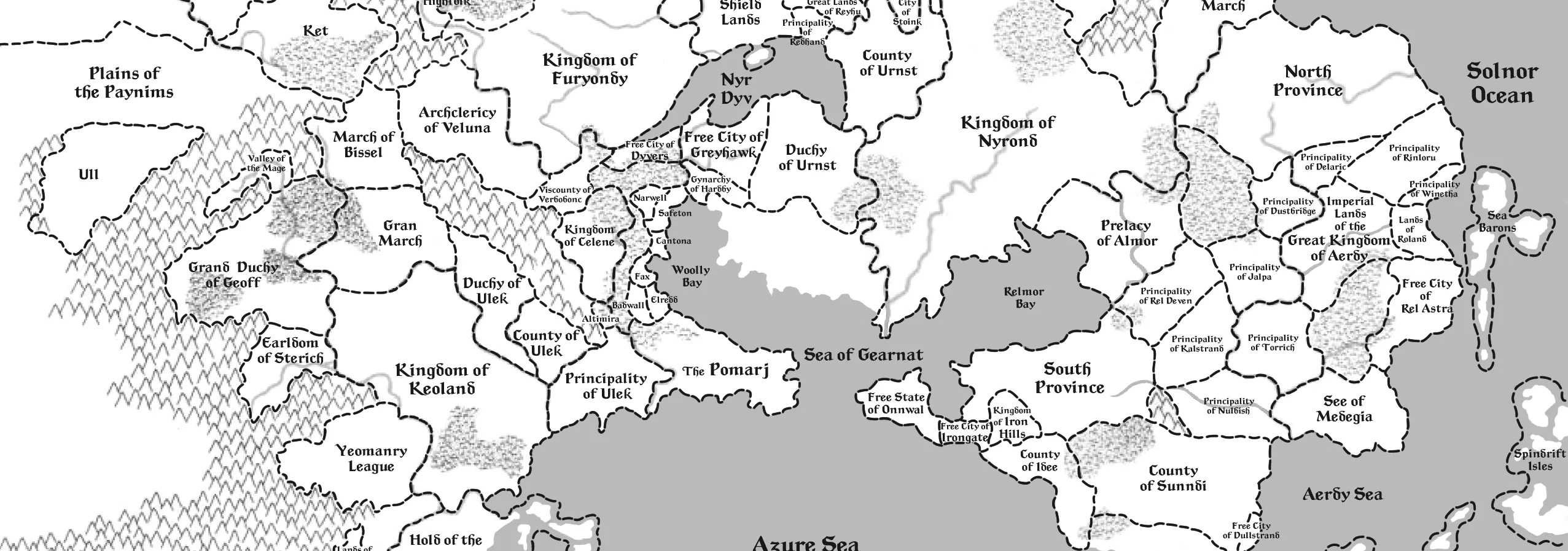
The eastern portion of Oerik, where most adventures took place, was known as the Flanaess.
Rather than creating a world dominated by a single empire, Gary populated the Flanaess with dozens of independent kingdoms, city-states, tribal lands, and wilderness regions. Powerful nations stood beside haunted forests and monster-infested mountains. Ancient civilizations had risen and fallen long before the current age, leaving behind ruins waiting to be explored.
Most importantly, the setting was intentionally incomplete.
Large portions of the map contained only a few sentences of description, encouraging referees to make the world their own.
The World of Greyhawk Folio
By the end of the 1970s, Greyhawk had grown far beyond the halls of Castle Greyhawk and the streets of the Free City. Convention adventures, articles in Dragon Magazine, and countless stories shared among players hinted at a much larger world waiting to be explored. Fans wanted to know what lay beyond the next mountain range or across the distant sea.
TSR answered that question in 1980 with the publication of The World of Greyhawk Fantasy World Setting, commonly known today as the Folio Edition.
The set consisted of a thirty-two-page guidebook accompanied by two large, beautifully illustrated maps of the Flanaess created by artist Darlene Pekul. For the first time, players could see the kingdoms and wilderness regions that had previously existed only as scattered references. Furyondy, Keoland, the Great Kingdom, Iuz, and the Free City of Greyhawk all found their places upon a single map.
Unlike later campaign settings that sought to define every village and historical event, the Folio embraced simplicity. Most nations were described in only a few paragraphs, leaving vast stretches of the map open for individual referees to develop. This balance between established lore and creative freedom became one of Greyhawk’s defining strengths.
For many players, the Folio remains one of the finest campaign setting products ever published, offering just enough information to inspire adventures without overwhelming the imagination.
The 1983 Boxed Set
Three years later, TSR returned to the setting with an expanded edition that would become the definitive version of classic Greyhawk.
Released in 1983, The World of Greyhawk Fantasy Game Setting—often simply called the Greyhawk Boxed Set—retained Darlene’s iconic maps while greatly expanding the accompanying material. The new guidebook nearly doubled the amount of available information, providing richer descriptions of the nations, peoples, and history of the Flanaess.
The boxed set introduced detailed calendars, weather tables, encounter charts, heraldry, and expanded historical notes that helped transform Greyhawk from a collection of adventure locations into a living world. The deities of the Flanaess received greater attention, while political rivalries and ancient conflicts gave referees countless opportunities to build their own campaigns.
Perhaps the boxed set’s greatest achievement was its restraint. Rather than telling players exactly what stories to experience, it presented a world filled with possibilities and trusted each gaming group to create its own legends.
By the early 1980s, Greyhawk had become TSR’s premier campaign setting and the standard against which future fantasy worlds would be measured. Its influence can still be seen in countless role-playing games published decades later.
Beyond Gary Gygax
The 1983 boxed set marked the culmination of Gary Gygax’s vision for the World of Greyhawk. While he continued to contribute to the game, the publication of the boxed set effectively closed the first chapter in the setting’s history. Shortly afterward, Gygax departed TSR, and stewardship of Greyhawk passed to other designers.
It is important to remember that the classic Greyhawk presented in the Folio and the 1983 boxed set exists at a very specific moment in history: Common Year 576 (CY 576). The kingdoms of the Flanaess stand in an uneasy balance. Ancient evils stir, rival nations scheme against one another, and the future remains unwritten. It is a world poised on the edge of great change.
Over the following years, TSR revisited Greyhawk through a series of sourcebooks and adventures that expanded the setting while advancing its timeline. These later works were created by talented authors such as Carl Sargent, Anne Brown, and others, each adding their own perspective to the world that Gary had begun.
Among the most influential later products were:
Greyhawk Adventures (1988) A hardcover collection of lore, monsters, magic items, and setting material designed for Advanced Dungeons & Dragons First Edition.
The City of Greyhawk Boxed Set (1989) A detailed exploration of the Free City itself, expanding the heart of the setting into a living campaign environment.
WGR5: Iuz the Evil (1993) An in-depth examination of the demigod Iuz and his northern empire.
The Marklands (1993) A sourcebook detailing Furyondy, Nyrond, and the aftermath of growing conflict across the Flanaess.
The Scarlet Brotherhood (1999) A comprehensive look at one of Greyhawk’s most mysterious and dangerous factions.
From the Ashes (1992) Perhaps the most significant evolution of the setting, advancing the official timeline to CY 585 following the devastating Greyhawk Wars.
The publication of From the Ashes dramatically changed the political landscape of the Flanaess. Kingdoms fell, borders shifted, rulers died, and the world became darker and more uncertain than the relatively stable era presented in the 1983 boxed set.
At the same time, the game itself was changing. The original Dungeons & Dragons game had evolved into Advanced Dungeons & Dragons, which in turn gave way to AD&D Second Edition in 1989. Later decades would see the arrival of Dungeons & Dragons Third Edition, 3.5 Edition, Fourth Edition, and the current Fifth Edition, each bringing new rules and interpretations of the setting.
Because of these changes, many longtime fans view Greyhawk as existing in several distinct eras. Some prefer the classic world of CY 576 as presented by Gary Gygax, while others embrace the later timeline and its sweeping historical events. Neither approach is wrong; each represents a different chapter in the history of the Flanaess.
For the purposes of OERIK, our journey begins where Gary left it: the World of Greyhawk Fantasy Game Setting (1983), in the year CY 576. It is a world of limitless possibility, where the greatest wars have not yet been fought, the old kingdoms still stand, and the next great legend may be written by your own adventuring party.
Following the publication of From the Ashes, Greyhawk entered a new phase with the launch of Living Greyhawk in 2000. Organized by the RPGA (Role Playing Gamers Association), Living Greyhawk became one of the largest shared-world campaigns ever created. Players around the world took part in adventures set across the Flanaess, with each real-world region assigned responsibility for developing and running adventures in a specific Greyhawk nation.
The Living Greyhawk campaign advanced the official timeline beyond the Greyhawk Wars and greatly expanded the amount of published material available for many regions of the setting. Hundreds of adventures, sourcebooks, and regional supplements were produced, giving players an unprecedented opportunity to explore the world in depth. For many fans, Living Greyhawk served as their introduction to the setting and helped preserve interest in Greyhawk during a period when it was no longer TSR’s primary campaign world.
Although Living Greyhawk introduced new characters, events, and historical developments, it remained firmly rooted in the foundation established by Gary Gygax’s original vision. Much like the earlier published works, its material can be adopted in whole, in part, or simply used as inspiration for individual campaigns.
Why Greyhawk Endures
More than fifty years after its creation, Greyhawk continues to hold a special place in the history of fantasy role-playing.
Part of that appeal lies in its origins. Greyhawk was not designed as a novel or a scripted story. It grew naturally from years of adventures around Gary Gygax’s gaming table, expanding one dungeon, one kingdom, and one legend at a time.
Unlike many later campaign settings, Greyhawk rarely tells players where they must go or what stories they must experience. Its kingdoms are filled with political intrigue, its wilderness hides the ruins of forgotten civilizations, and its dungeons conceal treasures and terrors beyond imagination. The setting provides the stage, but the heroes are the adventurers created by the players themselves.
Perhaps that is why every generation discovers Greyhawk anew. Some know it through the original Folio, others through the 1983 boxed set, the Greyhawk Wars, or Living Greyhawk. Each era adds another chapter to the setting’s long history.
For OERIK, however, our journey begins at the dawn of the classic age—in the year 576 Common Year, before the great wars reshaped the Flanaess, when the future remained unwritten.
But before we can explore its adventures, we must first understand the world itself.
Welcome to Oerth.
Comments