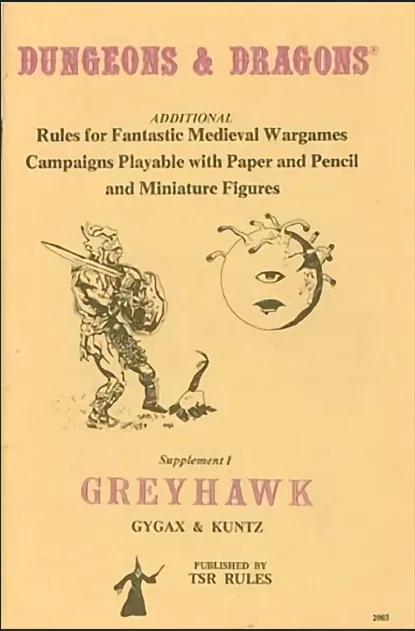
Before there was Advanced Dungeons & Dragons, before the Player’s Handbook, and before the World of Greyhawk was ever mapped, there was Supplement I: Greyhawk.
Published only a year after the original three little brown books, this slim digest introduced many of the ideas that would become inseparable from Dungeons & Dragons. Despite its title, it is not a setting guide but a collection of rules, monsters, spells, and treasures born directly from the campaigns run by Gary Gygax and Rob Kuntz beneath the legendary halls of Castle Greyhawk.
Historical Context
In 1974, Dungeons & Dragons was unlike any game the world had ever seen. The original boxed set provided the foundation for fantasy role-playing, but many of the concepts players now consider essential simply did not exist. There was no thief class to pick locks or disarm traps, no paladin championing Law and virtue, no variable weapon damage, and no high-level spells capable of reshaping reality.
The rules were evolving almost weekly as Gary Gygax and Rob Kuntz ran adventures beneath the ever-expanding levels of Castle Greyhawk. When players attempted something the rules did not cover, a new rule was created. If a monster proved too simple, it was reinvented. If a magic item made the game more exciting, it found a permanent place in the campaign.
Rather than publish a description of the Greyhawk setting itself, TSR chose to collect these innovations into a single volume. Released in March 1975, Supplement I: Greyhawk became the first expansion for the original Dungeons & Dragons game and introduced dozens of ideas that would eventually define the hobby.
Ironically, despite its title, readers looking for maps of the Free City of Greyhawk or histories of the Flanaess would find almost none of them. Instead, they discovered something far more influential: the rules, monsters, spells, and treasures that had grown naturally from the world’s most famous home campaign.
Looking back more than fifty years later, it is difficult to imagine Dungeons & Dragons without the thief, the beholder, the lich, or the Deck of Many Things. All of them first appeared in these sixty-eight digest-sized pages, making Supplement I: Greyhawk not merely an expansion, but one of the foundational texts of the entire hobby.
What’s Inside?
At first glance, Supplement I: Greyhawk appears to be a modest sixty-eight-page expansion for the original Dungeons & Dragons rules. In reality, it is a blueprint for nearly every edition that followed. Many of the mechanics, classes, spells, monsters, and treasures that players now consider inseparable from the game made their debut within these pages.
New Heroes
The supplement introduces two character classes that would become permanent fixtures of fantasy role-playing.
The thief adds stealth, agility, and problem-solving to the adventuring party, bringing skills such as opening locks, removing traps, climbing walls, and moving silently into the game for the first time.
The paladin expands the fighting-man into a holy champion of Law, rewarding strict codes of conduct with powerful divine abilities and establishing one of fantasy gaming’s most enduring archetypes.
The book also introduces half-elves as a player race and presents the first rules for multi-class characters, greatly expanding character possibilities.
Rules That Changed the Game
Some of the most influential additions are also the simplest.
Variable weapon damage replaces the original system where nearly every weapon inflicted the same damage. Daggers become light weapons, two-handed swords become devastating, and weapon choice suddenly matters.
Characters also become more distinct as ability scores gain mechanical importance. Strength modifies attacks and damage, Dexterity improves defense, Constitution affects survivability, and exceptional Strength gives fighters unique advantages.
Each class now receives its own hit die, creating meaningful differences between warriors, thieves, clerics, and magic-users.
Magic Without Limits
Greyhawk dramatically expands spellcasting by introducing dozens of new spells and extending progression into the highest levels of magic.
Magic Missile, Web, Wish, Gate, Time Stop, Power Word Kill, and many other legendary spells all make their first appearance here. Many remain recognizable in modern editions with only minor changes.
Monsters That Became Legends
Few books have contributed so many iconic creatures to fantasy gaming.
The beholder, lich, gelatinous cube, carrion crawler, displacer beast, rust monster, bugbear, lizard man, and many others first emerge from these pages, forever changing what players expect to encounter beneath the dungeon.
Treasures Worth Dying For
The supplement also introduces an astonishing collection of magical treasures. Vorpal swords, portable holes, rods of lordly might, decks of many things, figurines of wondrous power, and spheres of annihilation all make their debut.
Not every item is a blessing, however. Greyhawk embraces the ruthless spirit of early D&D with cursed objects that can instantly ruin—or end—a character’s career, reminding players that curiosity can be as dangerous as any dragon.
Greyhawk Relevance
The greatest irony of Supplement I: Greyhawk is that it contains almost no information about Greyhawk itself.
Readers expecting maps of the Free City, descriptions of the Flanaess, or biographies of famous characters will search in vain. Aside from a brief mention of the legendary Castle Greyhawk, the mysterious Great Stone Face, and a few passing references, the setting remains almost entirely hidden.
Yet no product is more fundamentally connected to Greyhawk.
Every rule, spell, monster, and magic item in this supplement was born from the adventures of Gary Gygax, Rob Kuntz, and their players beneath the halls of Castle Greyhawk. The thief class was created because the dungeon needed someone who could deal with locks and traps. New monsters appeared because experienced adventurers required new challenges. New spells and treasures evolved naturally as the campaign expanded into deeper and more dangerous levels.
In many ways, this supplement captures Greyhawk before it became a published world. It presents the living campaign rather than the setting itself—a snapshot of a game still being invented one session at a time.
For Greyhawk enthusiasts, that makes Supplement I: Greyhawk an invaluable historical document. While later publications describe the nations, gods, and geography of Oerth, this little digest reveals something even rarer: how Greyhawk was actually played by its creators.
If the 1980 World of Greyhawk Folio introduced readers to the world, Supplement I: Greyhawk introduced them to the imagination that created it.
Greyhawk Connection
Setting Material: ★☆☆☆☆
Campaign Influence: ★★★★★
Historical Significance: ★★★★★
Despite sharing its name with the setting, this is not a Greyhawk sourcebook. Instead, it is the rulebook that grew directly from the original Castle Greyhawk campaign and introduced many of the ideas that would define the hobby for the next fifty years.
Where It Shows Its Age
No book is perfect, and Supplement I: Greyhawk proudly wears the scars of a game that was still discovering itself.
The organization can be bewildering to modern readers. Rather than presenting a complete set of rules, the supplement assumes constant reference to the original three little brown books, adding new material while quietly revising existing mechanics. Important changes are often buried in paragraphs with little indication that they replace previous rules.
Some design choices are equally experimental. The optional weapon-versus-armor modifiers require extensive tables that slow combat considerably, and the variable damage assigned to monsters can feel surprisingly arbitrary. A giant bird may strike as hard as a mythical beast, while creatures of vastly different sizes sometimes inflict nearly identical wounds.
The magic items reflect an era when dungeon exploration was as much a contest between referee and players as a collaborative story. Cursed treasures are often spectacularly unforgiving. The Scarab of Death, Bag of Devouring, and other infamous items can destroy a character with little warning, reinforcing the old-school lesson that greed is often deadlier than any monster.
Even the artwork captures a hobby still finding its identity. Some illustrations have become iconic, while others possess a wonderfully awkward charm that reminds readers these books were produced by enthusiastic gamers rather than a polished art department.
Yet these imperfections are part of the supplement’s appeal. Every page feels experimental, as if the reader is watching Dungeons & Dragons evolve in real time. Rules are introduced because someone at Gary Gygax’s table needed them. Monsters exist because a referee wanted to surprise experienced players. The book is less a finished product than a snapshot of a living campaign constantly growing and changing.
That sense of discovery is what makes Supplement I: Greyhawk so fascinating more than fifty years after its publication. It is not merely a historical artifact—it is a record of the moment when fantasy role-playing was inventing itself.
Should You Hunt It Down?
Absolutely.
If your interest is simply playing modern Dungeons & Dragons or Adventures Dark & Deep, nearly every rule in Supplement I: Greyhawk has been rewritten, reorganized, and expanded in later publications. You do not need this supplement to enjoy old-school gaming.
But that is missing the point.
This little digest is the moment when Dungeons & Dragons began to resemble the game we know today. The thief steps from the shadows for the first time. The paladin takes up his holy quest. The beholder opens its central eye. The lich achieves immortality. The Deck of Many Things waits to tempt reckless adventurers, and the Wish spell promises unlimited possibilities.
More importantly, every page reflects the experimental spirit of the original Greyhawk campaign. The rules were not created by committee or market research; they were forged at the table because Gary Gygax, Rob Kuntz, and their players needed them for the next night’s adventure.
That spirit is still inspiring today.
Modern readers will find a book that is occasionally confusing, frequently unbalanced, and undeniably primitive by contemporary standards. They will also find a remarkable amount of creativity packed into sixty-eight digest-sized pages and a direct connection to the origins of the hobby.
For historians of Dungeons & Dragons, collectors of classic TSR products, and devotees of Greyhawk, Supplement I: Greyhawk remains an essential volume—not because it describes the World of Greyhawk, but because it preserves the ideas that grew from its legendary dungeons.
OERIK Verdict
Status: Essential
Not because it is the best-written supplement ever published, but because it is one of the most influential. Few books can claim to have introduced entire character classes, iconic monsters, legendary spells, and enduring magic items while simultaneously laying the foundation for every edition that followed.
More than fifty years after its publication, Supplement I: Greyhawk is still doing exactly what it was meant to do: inspiring referees to create something new.
Comments