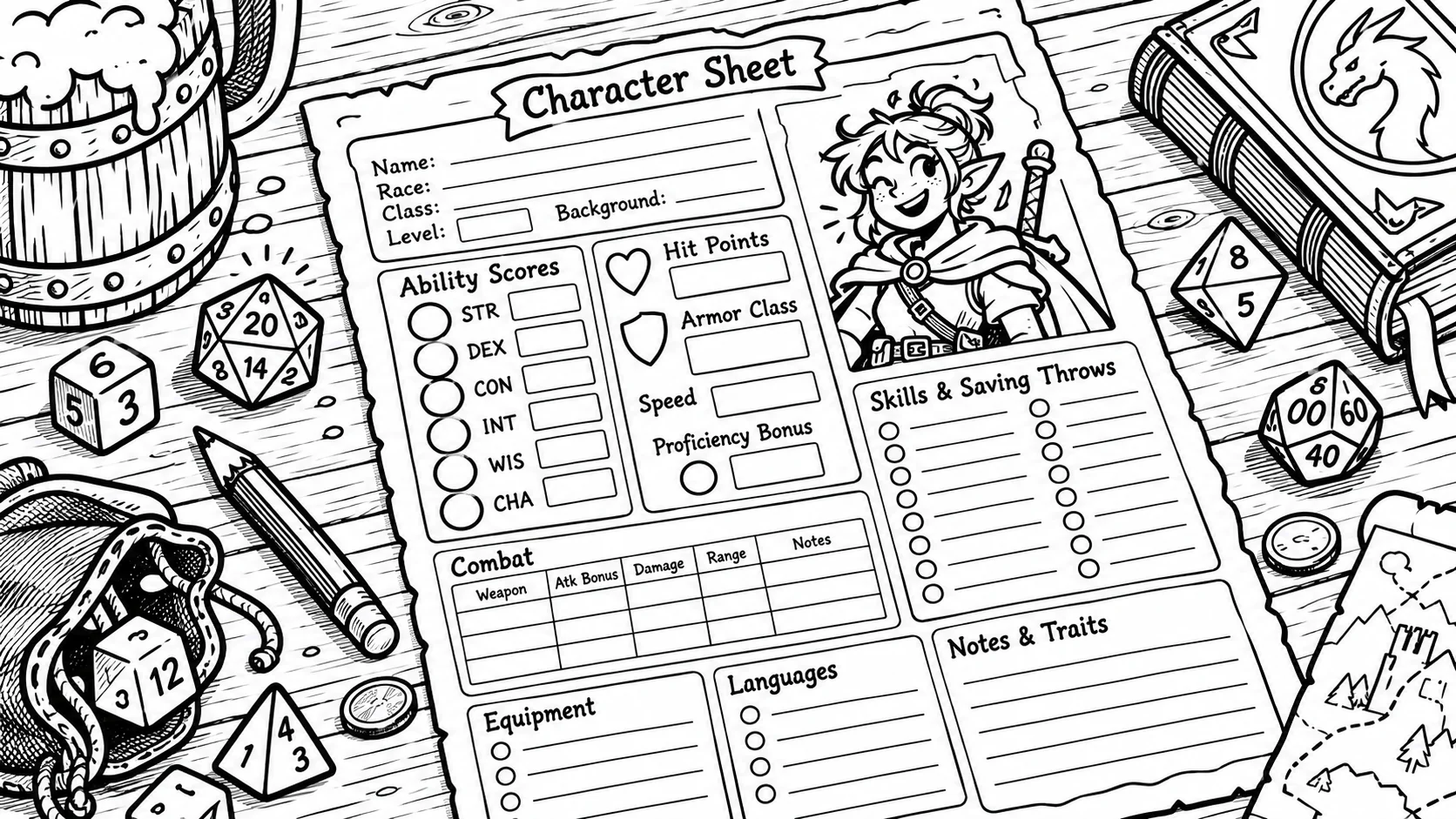
“The greatest treasures in fantasy role-playing are not found in dungeons, but in the stories shared around the table.”
Welcome to the Table
Every player remembers their first adventure.
Perhaps it begins in a crowded tavern, a dusty village square, or at the entrance to a forgotten ruin where weathered stone steps disappear into darkness. Dice are rolled, character sheets are unfolded, and someone asks the question that has started countless campaigns over the last fifty years: “What do you do?”
If Adventures Dark & Deep™ is your first experience with classic fantasy role-playing, you may discover that the game expects something different than many modern systems. The rules are important, but they are only the foundation. Success comes from careful planning, curiosity, teamwork, and the willingness to solve problems through your own ideas rather than simply searching your character sheet for the right ability.
That may sound intimidating at first, but it is also one of the greatest strengths of old-school gaming. Every locked door is a mystery, every strange statue invites investigation, and every expedition into the wilderness offers the possibility of discovering something no one at the table expected.
This article is not intended to teach every rule in the game. Instead, it offers the practical advice that experienced players pass along to every new adventurer before the party lights its first torch and steps into the unknown.
The road is long, the dungeon is dark, and your companions are waiting. Let’s begin.
Bring the Right Tools
Every experienced adventurer knows that preparation begins long before the party reaches the dungeon entrance. A few simple items can keep the game moving, help the party stay organized, and allow you to focus on the adventure instead of searching for supplies.
If you own a copy of the Adventures Dark & Deep™ Core Rulebook, bring it with you. While the referee will usually have a copy available, having your own lets you quickly reference spells, equipment, classes, and other rules without interrupting play.
Perhaps the most overlooked item on this list is a simple notebook. Write down the names of taverns, merchants, priests, and suspicious strangers. Record rumors that seem unimportant today, treasure maps found at the bottom of a chest, or the cryptic inscription carved above a forgotten doorway. Months later, those notes may solve a mystery or lead the party back to a place everyone else has forgotten.
Graph paper is equally valuable. In classic fantasy role-playing, careful mapping can reveal secret passages, hidden chambers, or the safest route back to the surface when torches are burning low. Even if another player volunteers to map, keeping your own notes and sketches helps you understand the world your characters are exploring.
Most importantly, arrive ready to play. Have your character sheet organized, your dice within reach, and your attention on the table rather than your phone. Every prepared player helps the game flow more smoothly and allows the referee and the rest of the party to spend less time looking for information and more time creating memorable adventures.
Player Essentials
Essentials
- Pencil with eraser
- Character sheet
- Set of polyhedral dice
- Notebook or note paper
Nice to Have
- Extra pencils
- Graph paper for mapping
- Dice bag
- Rulebook bookmarks
- A folder for character records
Tech at the Table
When the first fantasy role-playing games appeared in the 1970s, every player arrived with little more than a character sheet, a handful of dice, a pencil, and perhaps a notebook filled with maps and rumors. Today’s gaming table often looks very different. Tablets display rulebooks, phones hold character sheets, laptops track initiative, and online campaign journals replace three-ring binders.
None of these tools are inherently good or bad. In fact, many of them can make the game easier to run and more enjoyable to play. A searchable PDF is often faster than flipping through hundreds of printed pages, and a shared campaign journal allows every member of the party to review notes between sessions.
The key is remembering why the technology is there.
It should support the adventure, not compete with it.
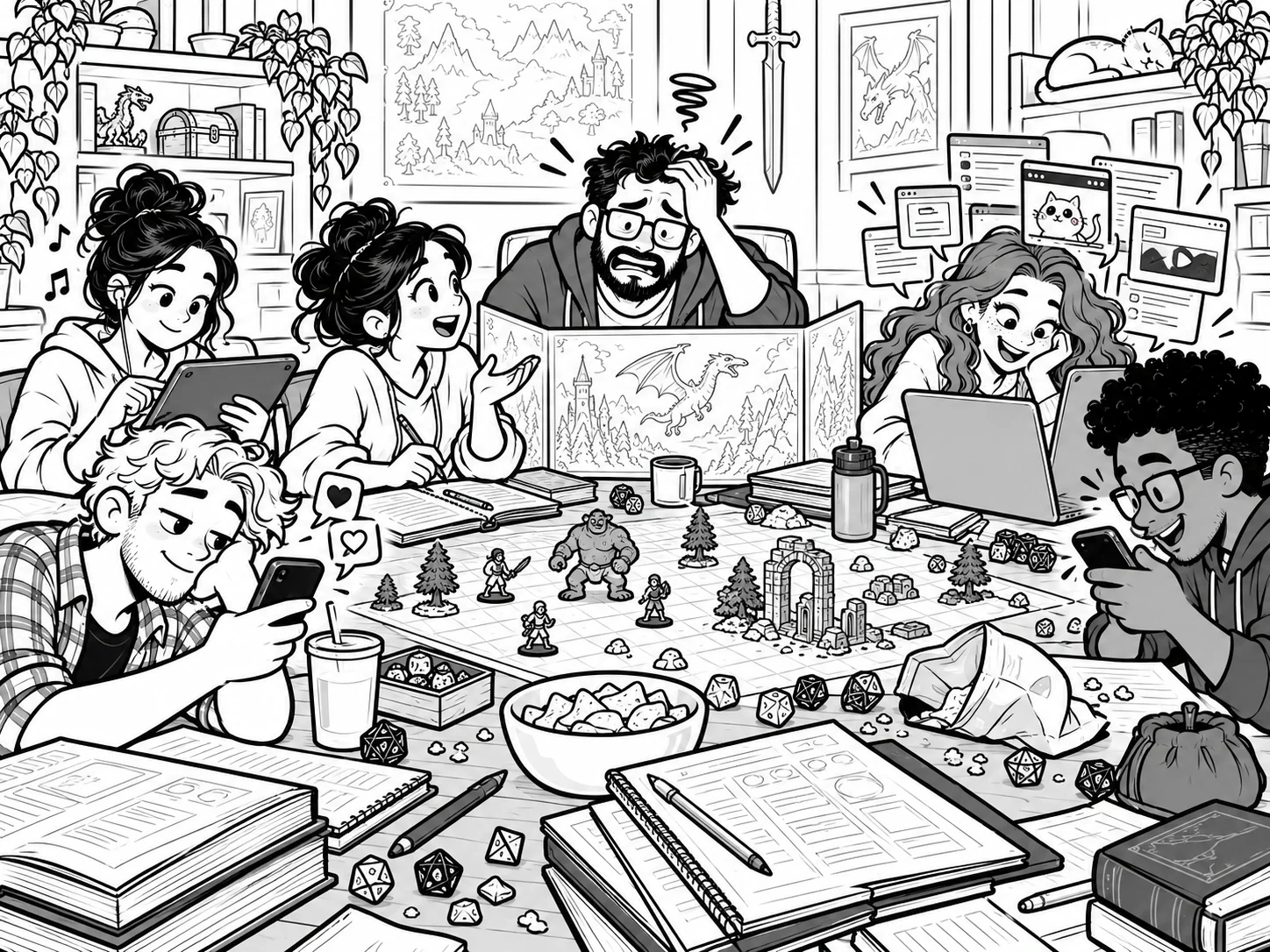
Using a tablet to look up a spell or check your equipment list helps keep the game moving. Using the same tablet to answer email, browse social media, or watch videos while another player is negotiating with the town guard sends a very different message: the game is no longer your focus.
Every gaming group develops its own expectations, and one of the easiest ways to become a better player is to respect the preferences of the Dungeon Master and the table. Some referees enjoy a fully digital game where players use tablets and online rulebooks. Others prefer a table free from phones and laptops, believing that paper character sheets and printed books create a more immersive experience. Neither approach is right or wrong—they are simply different ways to enjoy the hobby.
If you are joining a new group, ask about their expectations before the first session. A simple question such as, “Do you mind if I use my tablet for my character sheet and rulebook?” shows consideration for the referee and the other players. Once those expectations are established, honor them. Respecting the table’s style is far more important than insisting on your own.
Perhaps the greatest advantage of classic fantasy role-playing is that it is a shared experience. Players listen carefully because the thief’s discovery might save the party. They pay attention because a passing remark from an innkeeper may become the key to an adventure three months later. They stay engaged because every decision belongs to the entire group.
Whether your notes are written in a leather-bound journal or stored in an app, the most important tool you bring to the table is your attention.
When the referee asks, “What do you do?” the best players already know the answer—not because they were staring at a screen, but because they were fully present for every moment of the adventure.
Adventures Dark & Deep Is Different
If you are coming from another fantasy role-playing game, one of the first things you may notice is that Adventures Dark & Deep™ asks a different question.
Instead of asking, “What ability on my character sheet solves this problem?” it asks, “What would my character actually do?”
That small difference changes the way the game is played.
A locked door is not simply an opportunity to roll a skill check. Players might listen for sounds on the other side, examine the hinges, search for hidden mechanisms, look for cracks beneath the frame, or decide that forcing it open is too dangerous and explore another passage instead.
The same approach applies throughout the game. A suspicious merchant can be questioned, observed, followed through the marketplace, or researched at the local temple. A river might be crossed by building a raft, hiring a ferryman, searching for a ford, or using magic. The best solution is often the one the players invent rather than the one printed on a character sheet.
This style of play rewards curiosity and creativity. Ask questions. Examine your surroundings. Experiment with unusual ideas. The referee is not trying to trick you but to describe a living world that responds to your decisions.
New players sometimes worry that they need to know every rule before they can contribute. Nothing could be further from the truth. A player who pays attention, thinks carefully, and works with the party will often accomplish far more than one who spends the entire session searching for the perfect ability or spell.
That philosophy extends beyond solving puzzles and exploring dungeons. The world does not exist to guarantee success. Some monsters are too powerful to fight, some treasures are too dangerous to claim, and some mysteries take multiple adventures to unravel. The most experienced adventurers know that caution, preparation, and good judgment are often more valuable than the sharpest sword.
Perhaps the most important lesson of all is this: tell the referee what you want to do, not what rule you hope to use.
Describe your actions. Ask questions. Try ideas that no one expected.
You may be surprised where the adventure leads.
Think Like an Adventurer
In Adventures Dark & Deep™, your greatest resource is not your sword, your spells, or even your character sheet.
“The best solution is rarely written on your character sheet. It is waiting to be discovered by the players around the table.”
It is your ability to observe, plan, and make good decisions.
Every room, hallway, and wilderness trail presents choices. Experienced players quickly learn that charging ahead is rarely the best option. Instead, they slow down, ask questions, and pay attention to the details the referee is describing.
Listen at doors before opening them. Examine strange statues instead of touching them. Look up as well as down. Carry rope, extra torches, and spikes because you may need them when the unexpected happens.
Take notes when an old hermit mentions a ruined tower or a merchant complains about disappearances along the northern road. The smallest detail today may become the key to a future adventure.
Don’t be afraid to ask questions. How high is the ceiling? What is the room made of? Do the goblins appear frightened? Is there smoke coming from the chimney? The referee can only describe what the players investigate, and every answer gives the party more information upon which to base its decisions.
Perhaps the most important lesson is to remain curious. Not every door needs to be opened, not every monster needs to be fought, and not every treasure is worth the risk. Sometimes the best decision is to negotiate, retreat, or simply leave a mystery unsolved until the party is stronger and better prepared.
Old-school adventures reward careful thinking because the world exists independently of the characters. Traps are not placed to be found automatically. Secret doors do not reveal themselves simply because someone enters the room. Success comes from paying attention, working together, and using your imagination to overcome obstacles.
Many players discover that this becomes one of the most rewarding aspects of the game. Victories are memorable because they are earned through ingenuity as much as luck. Years later, groups rarely reminisce about a high die roll. They remember the time the thief discovered a hidden passage by noticing fresh candle wax on the floor, or when the party escaped certain doom by barricading a door with iron spikes and an overturned table.
The best adventurers are not always the strongest or the bravest.
Work as a Team
Very few heroes survive alone.
The greatest adventures are rarely remembered because of a single character’s accomplishments. They are remembered because a group of ordinary people trusted one another, combined their talents, and succeeded where none of them could have alone.
“The best parties succeed because every player contributes, every voice is heard, and every victory belongs to the entire group.”
Every class brings something valuable to the party. The fighter stands between danger and the rest of the group. The thief scouts ahead, searches for traps, and notices what others miss. The cleric protects and heals while serving as the party’s moral center. The magic-user contributes knowledge, planning, and carefully chosen spells that can change the course of an expedition.
No one character is expected to solve every problem.
Listen when another player has an idea. Share the information your character discovers. If the mapper asks how many doors are in the room, help count them. If the thief is searching for traps, give them the time to work. If the magic-user is studying an inscription, resist the urge to open every chest in sight.
The strongest parties communicate constantly.
Discuss marching order before entering the dungeon. Decide who carries the lantern, who watches the rear, and who keeps track of time and supplies. Small conversations like these may not seem exciting, but they often determine whether the party returns home with treasure or becomes another forgotten tale whispered in a tavern.
Remember that every player deserves a chance to contribute. Some adventures are won by a well-placed spell, others by careful negotiation, and still others by a clever idea from the quietest person at the table. Share the spotlight and celebrate each other’s successes.
Perhaps the greatest compliment a player can receive is not, “Your character was powerful,” but rather, “I’m glad you’re in the party.”
That is the kind of adventurer every group hopes to find.
Accept Risk
One of the first lessons every adventurer learns is that not every battle should be fought.
The world of Adventures Dark & Deep™ is not carefully balanced around the party’s current level or abilities. The ancient dragon living beneath the ruined keep does not become weaker because first-level adventurers wandered into its lair, and the band of orcs guarding the mountain pass will not politely attack one at a time simply because the party is outnumbered.
That uncertainty is not a flaw in the game—it is one of its greatest strengths.
Every decision carries weight because the outcome is never guaranteed. Entering a forgotten tomb with only two torches remaining is a meaningful choice. Crossing a rope bridge over a deep chasm should feel dangerous. Opening a locked chest without checking for traps should make the entire party hold its breath.
Sometimes the smartest decision is to retreat.
There is no shame in leaving a dungeon to recover spells, purchase supplies, recruit hirelings, or simply return another day with a better plan. Many legendary campaigns are filled with stories of adventurers who survived because they recognized that discretion is often the better part of valor.
“Knowing when to retreat is not a sign of failure, it is one of the oldest skills an adventurer can learn.”
Characters may be wounded. Equipment may be lost. Carefully made plans may fall apart in an instant. Occasionally, a beloved character may die.
While that may sound unforgiving, it also makes every success feel genuine. Escaping a collapsing temple with the treasure, negotiating peace instead of fighting a hopeless battle, or returning to town after barely surviving an impossible encounter creates stories that players remember for years.
Do not measure success by the number of monsters defeated.
Measure it by the difficult decisions made, the clever plans that worked, the disasters narrowly avoided, and the adventures your group will still be laughing about long after the campaign ends.
Every experienced adventurer has a story that begins with the words: “We really should have turned back.”
The fortunate ones are still around to tell it.
Respect the Table
The greatest adventures are created by groups of people who trust one another and work together toward a common goal. Rules and dice may shape the adventure, but the attitude each player brings to the table determines whether everyone has a good time.
Arrive on time and come prepared. Have your character sheet ready, your dice within reach, and your notes organized before the session begins. When the game starts, give it your attention. Listen while the referee describes a room, follow conversations between other players, and stay engaged even when the spotlight is on someone else.
Respect the referee’s rulings. No one remembers every rule, and every game occasionally requires a quick decision to keep the adventure moving. If a question arises, discuss it politely after the session rather than interrupting the momentum of the game with a lengthy debate.
Share the spotlight with the rest of the party. Every player deserves a chance to solve a puzzle, negotiate with an innkeeper, discover a secret passage, or deliver the final blow against a dangerous foe. Some of the most memorable moments at the table belong to the quiet player who finally has the opportunity to shine.
Help new players feel welcome. Answer questions, explain unfamiliar terms, and encourage creative ideas rather than correcting every mistake. Every experienced adventurer was once the person holding a twenty-sided die for the very first time.
People rarely remember the exact amount of treasure they recovered or the experience points they earned. They remember the friends they made, the impossible situations they escaped, and the stories that are retold years later whenever the dice come back out.
Being a good player is not about having the strongest character.
It is about making everyone else glad that you joined the party.
Leave the Table Better Than You Found It
Perhaps the simplest rule of all is the most important: Leave the table better than you found it.
Bring snacks if your group enjoys them. Help clean up when the session ends. Thank the referee for the time spent preparing the adventure. Celebrate the successes of the other players and laugh together when the plan inevitably falls apart.
Your First Adventure
Sooner or later, every player hears the same question.
“What do you do?”
For a moment the table grows quiet. Dice wait to be rolled. The referee looks around the room. Somewhere beneath an abandoned keep, inside a forgotten tomb, or along a lonely forest road, an adventure is about to begin.
You do not need to know every rule.
You do not need to memorize every spell or recognize every monster.
You do not need years of experience to become a valuable member of the party.
Bring a pencil, your character sheet, a handful of dice, and a willingness to explore. Listen carefully. Ask questions. Share your ideas. Help your companions, celebrate their successes, and don’t be afraid to try something unexpected. Some of the greatest moments in fantasy role-playing begin with a player saying, “I have an idea…”
You will make mistakes. Everyone does.
You will forget equipment, misread maps, trust the wrong innkeeper, and occasionally discover why old adventurers always carry an extra torch and fifty feet of rope. Those experiences are not failures—they become the stories that every group laughs about for years.
The goal is not to build the perfect character or win every encounter.
The goal is to become part of a shared story that belongs only to the people gathered around your table.
“Every legendary adventurer was once a first-level character standing before a closed door, wondering what waited on the other side.”
Years from now, you probably won’t remember how many gold pieces you found in your first dungeon or exactly how many hit points your fighter had at second level. You will remember the nervous excitement of opening that first dungeon door, the cheers when an impossible plan somehow worked, and the friends who were sitting beside you when it happened.
The road stretches into the unknown. Your companions are waiting. The torches are lit.
The referee smiles and asks one final time:
“What do you do?”
Comments